

How much can a river tell us?
This question inspires the poetic journey into which director Graciela Cassel leads the viewer in “Love is Lonely Hunter.”
Alongside this sensory itinerary, there ideally unfolds a short experimental film that seems to arise from the same expressive urgency: a girl walks alone through a city that could be anywhere, Rome, Chicago, Berlin, Tokyo, or no specific place at all. Urban space thus becomes a neutral, almost abstract container, where time stretches and narrative dissolves into pure perception.
The protagonist’s step, repetitive and silent, recalls the contemplative cinema of Wim Wenders, in which the journey is never merely movement but an inner quest.

In the same way, the camera lingers on details, a fox, a reflection, an empty street, with a sensitivity that evokes the lyrical grace of Terrence Malick, transforming everyday reality into an almost metaphysical experience.
Yet it is in the pauses, the silences, and the suspended gazes that a deeper echo emerges, one close to the spiritual tensions of Ingmar Bergman: solitude is not merely an urban condition, but an existential inquiry, a form of inner listening that traverses space and empties it.
The city, stripped of all frenzy, almost seems to observe the protagonist more than it is being observed. Sounds are sparse, often replaced by a silence that amplifies every gesture, every hesitation.
The shots, often static or only slightly moving, construct an emotional rather than a physical geography.
Every street walked does not lead to a destination, but to a spiritual awareness, to an inner growth.
Natural light, used by Graciela Cassel in “Love is Lonely Hunter” with great sensitivity, accompanies the passage of time like a slow breath.
The absence, or near absence, of dialogue reinforces the impression of a cinema that privileges the image as the primary form of storytelling.
In this sense, the film escapes any traditional narrative logic, choosing fragmentation and suspension.
It is a cinema that asks the viewer to inhabit space, not to understand it.
The movement of the protagonist thus becomes an almost ritual gesture, a practice of crossing through the world.
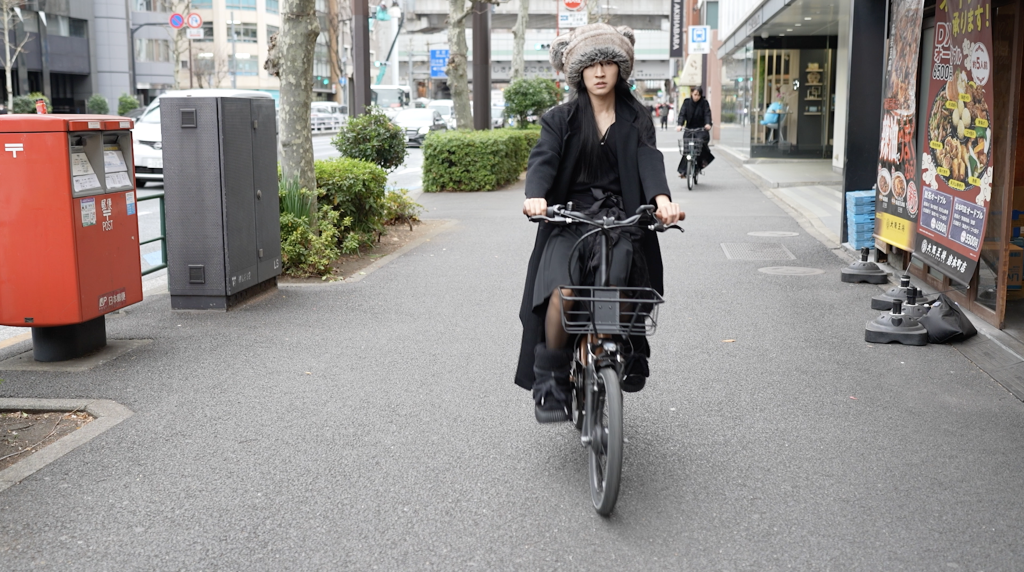
There is a constant search for authenticity, far removed from any narrative artifice.
The film seems to arise from the urgency to observe, rather than to tell.
And it is precisely in this act of observation that its most authentic strength is revealed.
This short urban road movie, in its essentiality, demonstrates how Graciela Cassel has consciously absorbed and reworked the principles of the Nouvelle Vague: narrative freedom, rejection of classical conventions, attention to reality, and visual improvisation.
The camera becomes light, almost invisible, following the flow of life without imposing a direction.

Like the river evoked at the beginning, this film too flows without ever truly stopping, carrying with it fragments of life, images, emotions.
And it leaves the viewer with the task of gathering them, interpreting them, and making them their own.