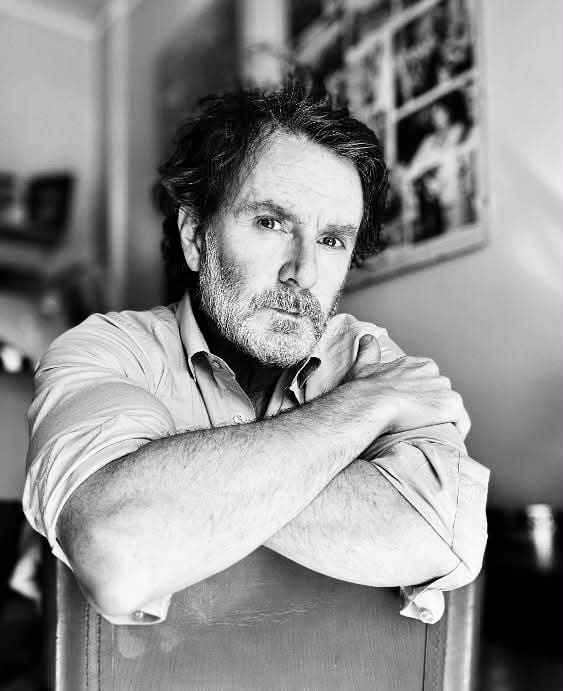
Who is Fabrizio Bartelloni?
I usually describe myself as both a jurist and a jester. In the first role, I practiced as a criminal defense lawyer for twenty-five years and have served as an honorary magistrate at the Public Prosecutor’s Office of Lucca for more than twenty years. At the same time, however, I have a second face—like the Joker—fascinated by words and by the way they transform into stories, songs, and performances.
I still haven’t figured out, though, which of my two personalities is Jekyll and which is Hyde.
What inspired you to dedicate a book to Fabrizio De André, and which aspect of his figure did you feel most compelled to explore?
My love for Fabrizio De André has deep roots. I have listened to him since early adolescence, and for me he has represented far more than a simple singer-songwriter. He became a true point of reference, not only culturally but also ethically. There was—and still is—something in what he said and sang that resonates deeply within me, making him feel extraordinarily close and kindred.
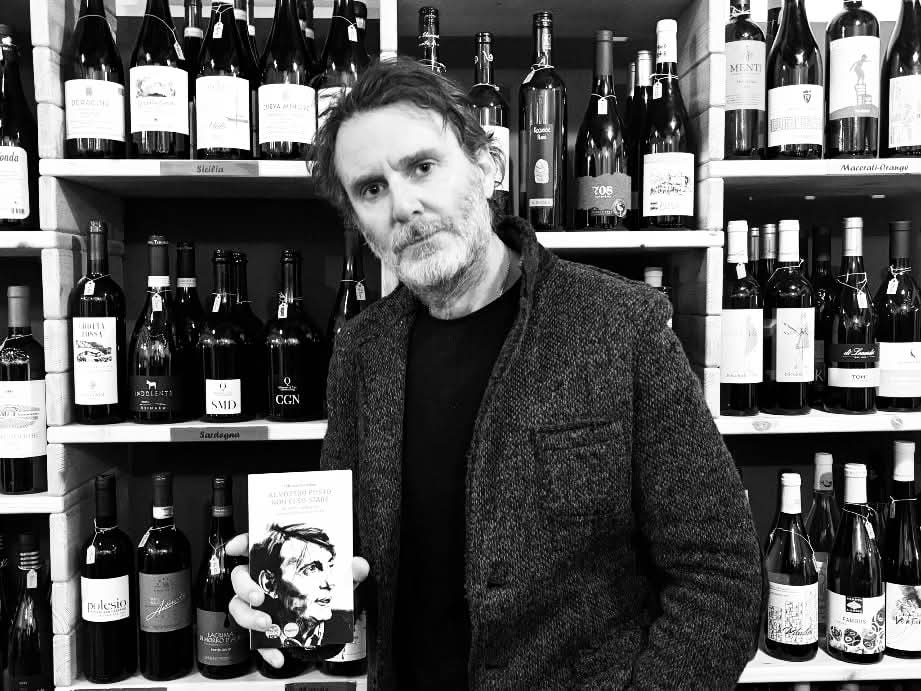
For this reason, I have always felt I owed him a kind of debt, one that I tried to repay, at least in part, by writing this book. To tell the story of his life and artistic journey, I chose the lens of justice, imprisonment, and the relationship with power—not only judicial power. These are themes that are part of my daily life, and they were central to De André’s work from the very beginning of his career—from La ballata del Michè to the songs on his final album, Anime Salve.
His unconventional view of human justice—focused more on understanding than condemnation, and hostile to every form of revenge and punitive populism—is a legacy that deserves not only to be preserved but also passed on.
De André was an artist who gave voice to the marginalized, the outcasts, and the contradictions of society. How relevant is his message today?
De André will always remain relevant because his gaze was directed, above all, toward humanity—in every sense of the word.
His reflections on the many human societies, different from one another yet always structured and organized by the dominant social class in a specific place and historical moment, and on the power that class exercises to preserve itself, are universal and timeless themes.
There will always be, on one side, the maiores who make laws in their own image and for their own protection, and on the other side, the vast ranks of the minores—the marginalized, the defeated, the outcasts of every kind—destined to become the designated victims of laws they had no part in creating.
During your research and the writing of the book, did you discover any lesser-known episodes from De André’s life and work?
Having cultivated a passion for and studied De André for many years, I already knew a great deal about him. However, I enjoyed rediscovering and exploring in greater depth the initiatives he quietly supported on behalf of prisoners.
These ranged from a long-secret visit to inmates at the Is Arenas penal colony in Sardinia, to his involvement in a training and support program for prisoners at San Vittore prison. Unfortunately, due to his premature death, that project remained largely an expression of intent.
At the same time, it was incredibly meaningful and educational to delve into the details of the kidnapping he suffered in 1979 and, above all, into his reaction—both inside and outside the courtroom—to that terrible experience. Most remarkable was the immediate forgiveness he extended to the kidnappers themselves. He did not even file a civil claim against them during the trial.
It was a concrete and extraordinary example of understanding rather than mere compassion. It impressed even Wim Wenders, who, captivated by Fabrizio’s music and eager to learn everything about him, was deeply struck when he learned of this episode.
If you had to choose one De André song as the key to understanding his human and artistic universe, which would it be and why?
Probably Il testamento di Tito, from the 1970 album La buona novella, because it contains everything.
It embodies his ability to change perspective in order to better understand the world—writing the entire album based on the apocryphal gospels rather than the canonical ones, and adopting, in its final song, the viewpoint of one of the thieves crucified alongside Christ rather than Christ’s own.
It reflects his attention to society’s marginalized, to those who live beyond the boundaries of legality largely because they exist outside the barbed-wire enclosures of the social class that holds power.
And it expresses his indomitable faith in an anarchic form of pietas—a natural inclination, constantly corrupted and undermined by power, to recognize the Other as equal to oneself and therefore to understand their weaknesses, fragilities, and miseries.
What is your impression of WILD FILMMAKER, a platform whose goal is to promote independent art on a global scale while ignoring the rules of the industry?
I can only have a completely positive opinion of it.
I believe that, in the arts, there is a huge problem of accessibility and awareness regarding everything that does not belong to the major industries—whether cinematic, musical, or literary.
We live in an era dominated by giants that swallow up every available space and make virtually invisible anything that exists and moves outside their sphere. In a way, this resembles De André’s “last ones,” forced to live on the margins by powers that overwhelm and crush them.
I believe that WILD FILMMAKER is something of a “Faber” within the cinematic universe—a reality striving to shine a spotlight on worlds that would otherwise remain hidden in the shadows.