WHO IS MAGNO BRASIL?
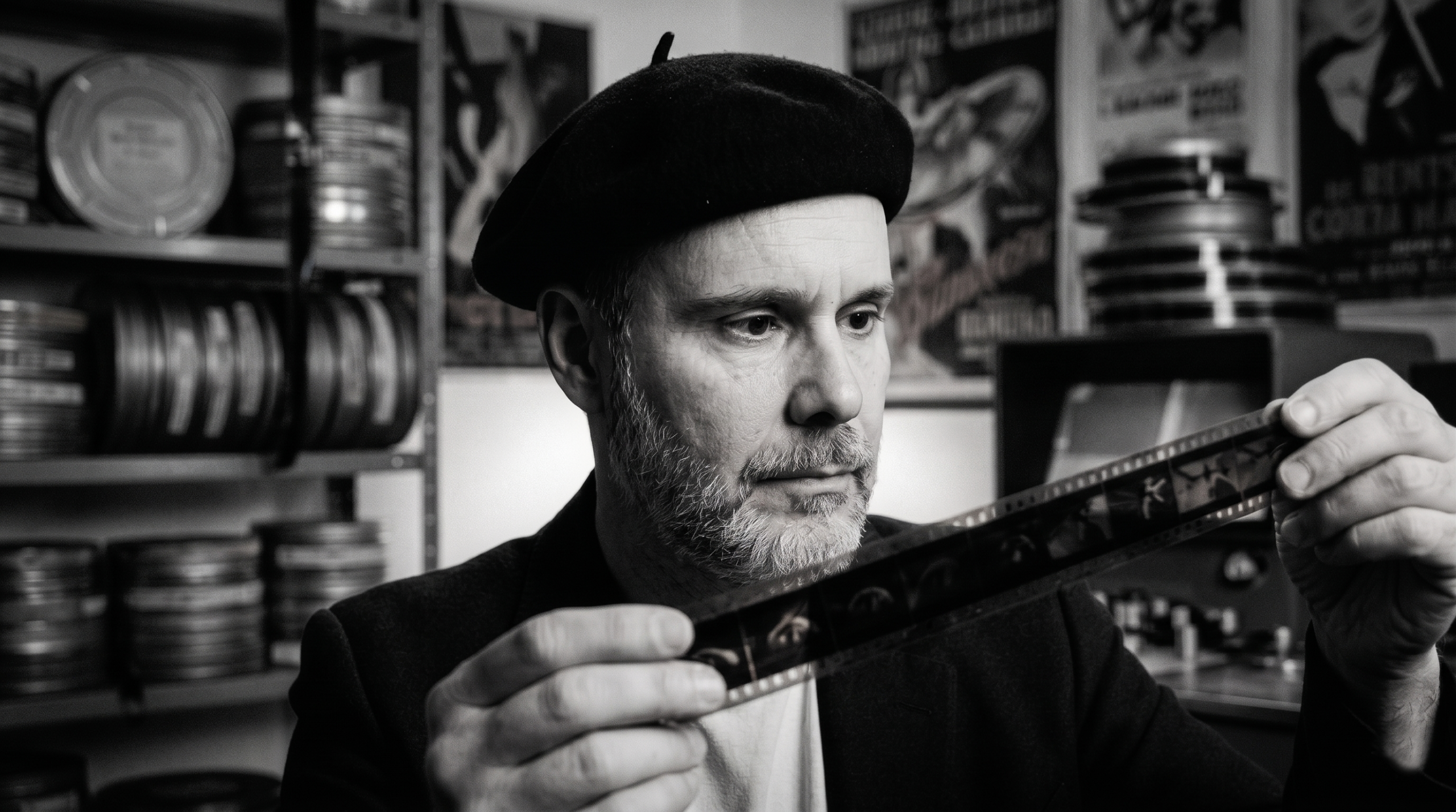
Magno Brasil is a Brazilian independent filmmaker, visual artist, educator, and creator of the NEO VISAGE cinematic language.
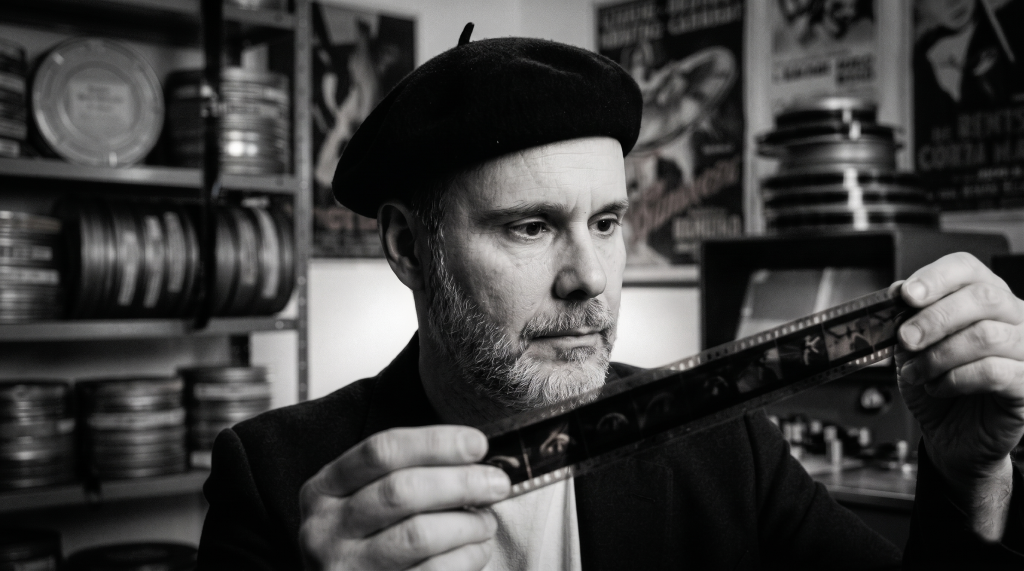
My relationship with cinema began very early. My father owned a small movie theater in the town where I was born, and I grew up surrounded by projectors, film reels, posters, and the almost magical atmosphere of movie screenings. Some of my earliest memories are connected to the sound of projectors and the feeling of watching entire worlds emerge on a screen. For many years, however, filmmaking itself felt distant from my reality. Cameras, studios, crews, and financing belonged to a world that seemed inaccessible to someone from my background. So I found another way to tell stories: pencils, ink, paper, comics, and illustration.
In 1991, I founded Visuart, an art school that would eventually become a reference in visual arts education in Brazil. Over the decades, I had the privilege of seeing former students build successful careers in animation, illustration, comics, and international entertainment. Some later worked on projects connected to Marvel, Disney, Star Wars, and major comic publishers.
That always moved me deeply. Yet there was also a quiet frustration. I was helping artists fulfill their dreams while my own
cinematic universe remained unrealized. For years I developed stories, characters, and projects, only to encounter the financial and structural barriers that often prevent independent creators from bringing ambitious visions to life.
Artificial Intelligence changed that reality. For the first time, I felt I had access to a creative bridge capable of transforming decades of accumulated imagination into moving images. IVA DELTA 7 emerged from that process, not as a technological demonstration, but as an authored cinematic universe with its own mythology, symbolism, and visual identity, shaped through what I call MYTHO-FUTURISM: a fusion of espionage, time travel, mythology, history, and speculative science fiction. Today, my work explores how emerging technologies can coexist with artistic direction, cinematic language, and authorship.
Tools evolve. Vision remains.
DO YOU REMEMBER THE EXACT MOMENT YOU FELL IN LOVE WITH CINEMA?
Yes. I believe it happened inside the projection booth of my father’s theater. I was fascinated not only by the films themselves, but by everything surrounding them: the mechanical rhythm of the projector, the smell of film stock, the darkness of the auditorium, and the collective sense of wonder shared by an audience.
Science fiction and fantasy had a particularly profound effect on me because they transformed the impossible into emotion.
Very early in life I understood that cinema was more than entertainment. It could be memory, philosophy, emotion, and visual poetry all at once. That feeling never left me. Even when I followed a path through comics, illustration, and education, the desire to make films remained alive. When generative technologies emerged decades later, I felt I had finally discovered a way to bring
the worlds I had carried within me since childhood into existence. That path would eventually lead to IVA DELTA 7 and the birth of NEO VISAGE.
TELL US ABOUT YOUR PROJECT “IVA DELTA 7”
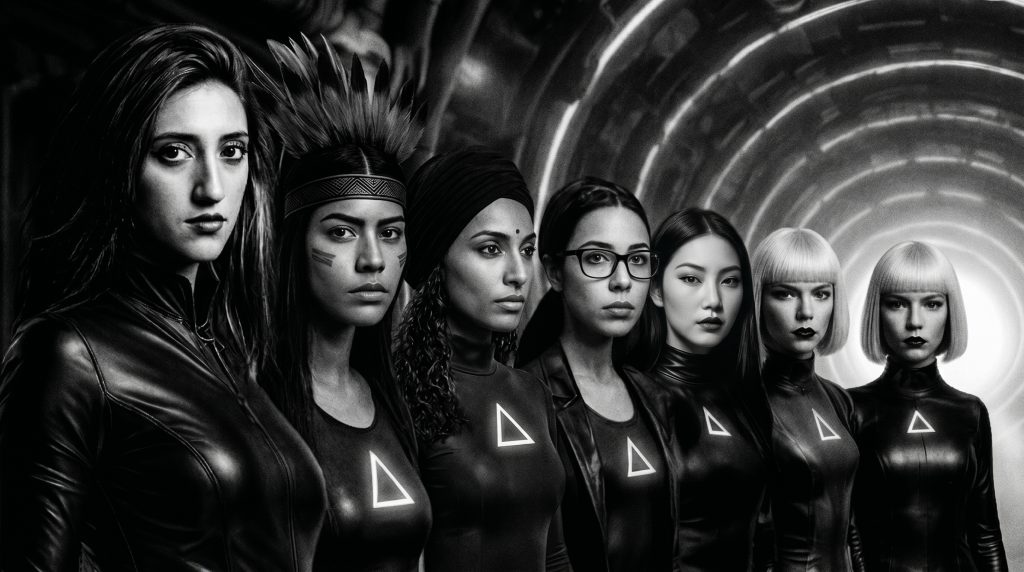
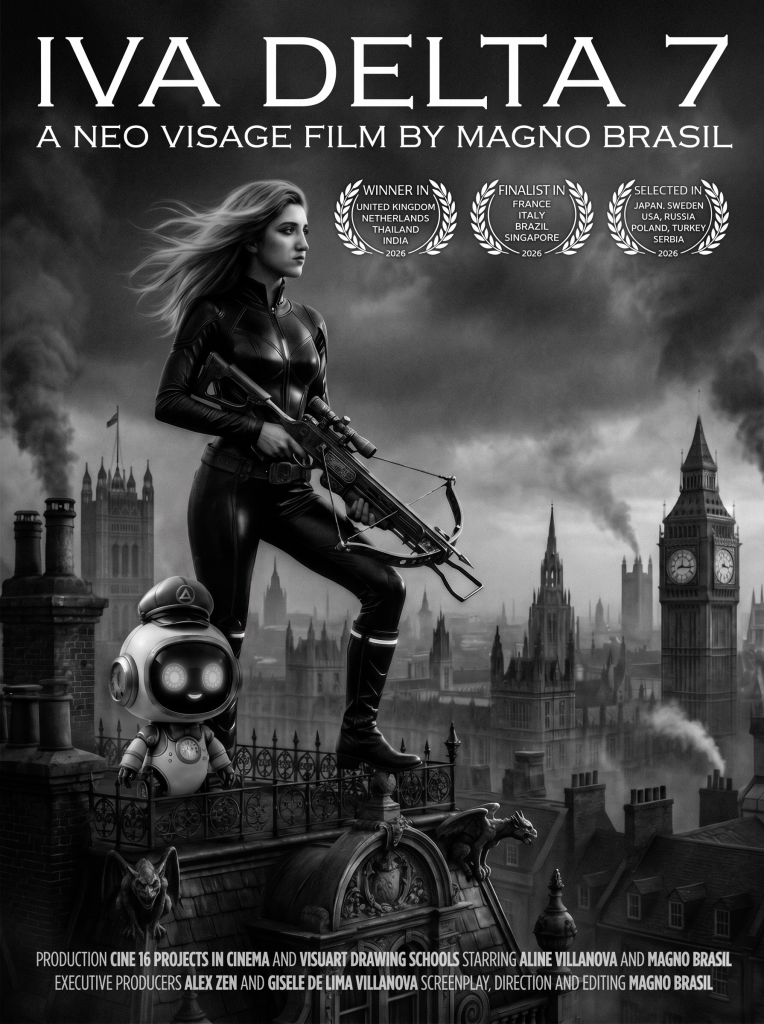
IVA DELTA 7 is an independent science-fiction cinematic universe built around memory, identity, artificial intelligence, war, mythology, and human emotion. Visually, the project introduces what I call NEO VISAGE, a cinematic language that combines
anime influences, comic-book composition, retrofuturism, painterly atmospheres, stylized three dimensional aesthetics, and classical cinematic framing into a single emotional experience. For me, Artificial Intelligence was never simply a production tool.
It also became part of the aesthetic. The technology allowed me to merge visual languages that I have loved throughout my life: classic science-fiction cinema, Japanese animation, pulp illustration, comic books, stop-motion fantasy, and experimental filmmaking. Narratively, the universe is built around MYTHO-FUTURISM, a fusion of espionage, time travel, mythology, history, and speculative science fiction. Music also became a fundamental part of its identity. The soundtrack draws inspiration from the orchestral spy scores of the 1960s, featuring dramatic brass sections, melancholic harmonies, and feminine vocal motifs that function almost like an invisible emotional narrator. Even when the protagonists are absent from the screen, the feminine presence continues to inhabit the universe through the music itself. Because at its core, IVA DELTA 7 is a profoundly feminine universe.
The agents who travel through time and alter history are women. They are not secondary figures. They are leaders, strategists, intellectuals, warriors, and guardians of memory. That vision comes directly from my own life. I grew up surrounded by strong women, my mother, grandmother, sister, as well as important women in my personal, emotional and creative life, who played a decisive role in shaping both my artistic and personal formation. In IVA DELTA 7, the feminine does not orbit the narrative.
It is the narrative. I often describe the production of IVA DELTA 7 as my own “Snow White moment.”
When Walt Disney decided to produce Snow White and the Seven Dwarfs, many believed animation could never sustain a feature-length emotional narrative. In a very different context, but driven by a similar spirit of experimentation, I believed AI could
become a legitimate cinematic language rather than merely a technological curiosity. The international recognition the film has received has reinforced that belief. The festivals are not recognizing the technology. They are recognizing authorship.
WHICH DIRECTOR INSPIRES YOU THE MOST?
I should probably begin by apologizing because I cannot answer this question with a single name. Every film I have watched throughout my life has left some emotional or aesthetic trace behind. Sometimes consciously, sometimes unconsciously.
Because IVA DELTA 7 belongs to a universe deeply connected to pop culture, science fiction, comic books, mythology, and geek culture, I will focus on the influences that most directly shaped its identity. The first is Maurice Binder. The classic James Bond title sequences fascinated me from childhood. Long before the story itself began, Binder was already creating atmosphere, mystery, emotion, and expectation through imagery, music, graphic design, and symbolism. He taught me that an opening sequence can emotionally prepare an audience for the journey ahead. That lesson stayed with me for life and strongly influenced the opening philosophy of IVA DELTA 7. Another major influence is worldbuilding itself. Stanley Kubrick, Ridley Scott, Akira Kurosawa, Christopher Nolan, and David Lean helped shape my understanding of atmosphere, scale, rhythm, visual composition, and narrative architecture. David Lean deserves special mention because his epic approach to cinema inspired my decision to
include an Overture and Intermission in IVA DELTA 7. I have always loved the feeling that certain films are not simply stories but events. Watching them feels almost like embarking on a journey through time itself. Russian cinema also occupies a special place in my artistic formation. Sergei Eisenstein profoundly influenced my understanding of editing as an emotional language. His
ability to generate meaning through montage, visual collisions, rhythmic construction, and expressive close-ups demonstrated that cinema could communicate ideas and emotions far beyond dialogue. Andrei Tarkovsky influenced me in a completely different way. Films such as Solaris taught me the power of contemplation, atmosphere, silence, and cinematic time itself. His camera movements often seem less concerned with action than with inviting reflection. They encourage the audience to inhabit a moment rather than simply observe it. That influence can be felt in several moments of IVA DELTA 7, particularly in the presentation of
Alpha, where I deliberately pursued a more meditative rhythm and visual presence. For that reason, the recent Official Selection of IVA DELTA 7 at the Sochi Film Festival carries special meaning for me. Russia is one of the places where cinematic language itself was profoundly expanded and redefined. Seeing an independent Brazilian science-fiction film created with generative AI tools find recognition there feels deeply rewarding because it reinforces something I have believed from the beginning: Technology is only a tool. What truly matters is authorship, cinematic language, emotional vision, and the ability to connect
with an audience. I am also deeply influenced by classic fantasy and science-fiction filmmaking. The chromatic atmosphere of Hammer Films, the stop-motion artistry of Ray Harryhausen, George Pal’s The Time Machine, Irwin Allen’s The Time Tunnel, and Franklin J. Schaffner’s Planet of the Apes all form part of the visual DNA of IVA DELTA 7. The Vortex itself is a direct homage to The Time Tunnel. Another influence that deserves special mention is Star Trek. Long before giant modern franchises dominated popular culture, Star Trek demonstrated that it was possible to build a powerful and enduring universe through ideas, characters, and vision rather than budget alone. What always fascinated me about the original series was its ability to use science fiction as a
vehicle for discussing humanity itself. Diversity, ethics, coexistence, prejudice, diplomacy, and the future of civilization were explored through stories that, on the surface, seemed to be adventures among the stars. That lesson had a profound impact on me.
Star Trek proved that ambitious worldbuilding does not necessarily emerge from unlimited resources. It emerges from strong ideas, compelling characters, and a coherent mythology. I believe that influence is present throughout IVA DELTA 7. Beneath the time travel, espionage, artificial intelligence, and mythology, the project is ultimately about people. About memory, identity, sacrifice, coexistence, and the human capacity to imagine better futures. In many ways, Star Trek taught me that science fiction can be both spectacle and reflection at the same time. Japanese animation also played an enormous role in shaping my magination.
Osamu Tezuka and Hayao Miyazaki taught me that fantasy, philosophy, poetry, melancholy, and emotion can coexist naturally within the same narrative. Their work demonstrated that imagination does not diminish depth. In many cases, it amplifies it.
Comic books were equally important. The IVA agents deliberately wear uniforms inspired by superhero iconography. I have always been fascinated by how modern superheroes resemble mythological archetypes, contemporary gods navigating sacrifice, destiny, identity, and moral dilemmas. The difference is that most superhero mythologies began with male heroes. In IVA DELTA 7, the mythology begins with heroines. The women are not supporting characters orbiting the narrative. They are the narrative.
Finally, Quentin Tarantino profoundly influenced me through his use of dialogue, tension, humor, and character construction.
One of my greatest challenges while making IVA DELTA 7 was proving that AI-generated characters could create genuine emotional empathy rather than simply visual spectacle.
I wanted audiences to care about the characters, laugh with them, reflect with them, and feel emotionally connected to their journeys. The response from audiences and international festivals suggests that they can. Ultimately, however, what inspires me most is not technology, spectacle, or even genre. It is authorship. I admire creators who build worlds that feel unmistakably their own. Creators whose films could not have been made by anyone else. That, for me, is the highest achievement a filmmaker can reach.
WHAT DO YOU DISLIKE ABOUT THE WORLD AND WHAT WOULD YOU CHANGE?
One of the things that concerns me most about the modern world is the enormous inequality in access to opportunity, particularly in the arts and cultural production. Throughout history, countless talented artists, writers, filmmakers, and creators have faced
financial, institutional, or bureaucratic barriers that prevented their ideas from reaching the public. Sometimes extraordinary stories disappear simply because their creators never had access to the resources required to make them visible. Perhaps that is one of the reasons I dedicated so much of my life to education. In 1991, I founded Visuart, which continues to operate today with the mission of preparing artists not only technically, but also professionally and humanly—people capable of combining talent with sensitivity, critical thinking, and an understanding of the complexity of the world around them. Maintaining an independent educational institution is not easy. We survive primarily thanks to the trust of our students. I often say that Visuart was never really a business.
It became a philosophy of life. If I could change one thing, it would be to create a world where artistic creation is more accessible
and original voices have a fair opportunity to be heard regardless of economic background, geography, or institutional connections.
The world needs more creators. More storytellers. And more opportunities for imagination to flourish.
HOW DO YOU IMAGINE CINEMA IN 100 YEARS?
I believe cinema will become far more immersive, interactive, and technologically fluid than anything we can currently imagine.
Artificial intelligence, virtual environments, neural interfaces, and real-time cinematic generation may radically transform the production process itself. Yet I also believe something fundamental will remain unchanged. Audiences will continue searching for emotion, beauty, symbolism, conflict, and meaning. Technology changes. Human curiosity does not. Throughout my career I have tended to embrace technological transitions rather than fear them. When digital art tools began transforming the illustration industry in the late 1990s, many artists resisted them. My school was among the first to teach digital painting, and we were heavily
criticized for it at the time. Today, those tools are standard across the industry. I witnessed a similar reaction with generative AI.
Where some saw a threat, I saw a new creative language waiting to be explored. For me, technology should never replace imagination. It should amplify it. I also believe cinema will become increasingly decentralized. Independent creators from regions
historically excluded from major production centers will gain the ability to reach global audiences directly.
In many ways, I believe we are already witnessing the beginning of that transformation. One hundred years from now, the tools will certainly be different. What will matter, as it always has, is whether someone still has a story worth telling. At our core, we are still the descendants of those who gathered around ancient fires at the end of the day to share stories. The screens may change, the technologies may evolve, but the human need to tell stories, and to listen to them, remains eternal.
WHAT IS YOUR IMPRESSION OF WILD FILMMAKER?
What I admire about WILD FILMMAKER is its genuine commitment to discovering and supporting independent voices.
Many platforms speak about originality while still favoring established structures and familiar names. WILD FILMMAKER seems genuinely interested in filmmakers who possess strong personal identities and distinctive artistic visions, regardless of where they come from. That matters enormously. Independent cinema survives because there are spaces willing to value experimentation, authorship, and creative courage. I believe publications like WILD FILMMAKER play an essential role in preserving that spirit and helping new voices reach an international audience.