-Who is Firouz FarmanFarmaian?
I’m an Iranian-born diasporic contemporary artist, filmmaker and musician. My family’s displacement following the 1979 Iranian Revolution, and our presence today across several continents, have shaped a very fluid idea of identity in my work.
At the same time, our roots reach back toward Central Asia and a nomadic heritage to which I have always felt connected — perhaps partly historically, partly mythologically, through imagination. That search has become an important territory in my work and led to projects such as Gates of Turan, developed for Kyrgyzstan at the 59th Venice Biennale.
My education in Paris moved between art, architecture and film. Two important influences also shaped me: Monir Shahroudy Farmanfarmaian, who showed me how tradition could become a radically contemporary language, and my grandfather, one of Iran’s important modern architects, who transmitted to me a fascination for the dialogue between classical culture and the avant-garde.
That intersection — displacement, memory, nomadism and experimentation — continues to connect everything I do across cinema, visual art and music. It is also what led me to co-found We R The Nomads, an independent creative platform through which we develop projects across these disciplines and increasingly produce our own films.
-Do you remember the exact moment you fell in love with cinema?
I owe my love of cinema completely to my father. From a very young age, he introduced me to Italian post-war neorealism and then to the extraordinary generation that followed — Antonioni, particularly Blow-Up and later The Passenger, Visconti, with The Leopard still one of my favorite films, and above all Fellini.
Fellini taught me something that has stayed with me ever since: that the frontier between imagination and reality doesn’t really exist. Somewhere along that very fine line between reality and fiction lies poetry, and that is still one of the territories I am constantly searching for in my own work.
Later, as a teenager and in my early twenties in Paris, that foundation opened onto the city’s cinéphile culture — Godard, Truffaut, Cassavetes, and the late-night screenings in the small cinemas of the Latin Quarter around Saint-André-des-Arts. From there came the discovery of the new cinemas of Asia and Iran, particularly Abbas Kiarostami and Wong Kar-wai, which opened another door entirely.
So there wasn’t really one precise moment when I fell in love with cinema. It was a language my father gave me very early, and one that I am still building.
-Tell us about your project “PATH”.
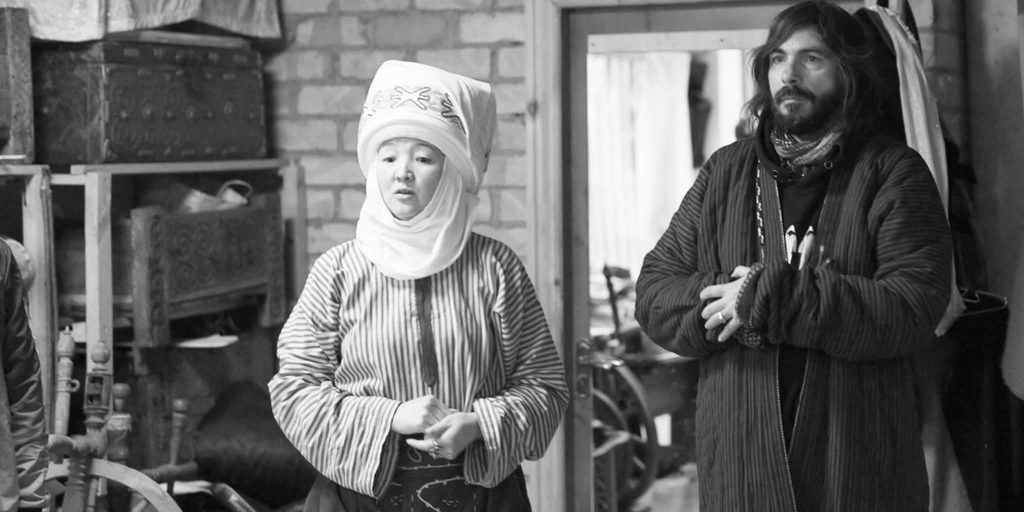
PATH began with a very specific adventure. I was invited to Kyrgyzstan as a cultural Ambassador to develop the country’s first national pavilion for the 59th Venice Biennale in 2022. What began as an artistic and cultural mission became an extraordinary journey through Kyrgyzstan, its landscapes, communities and contemporary identity, leading eventually to the installation of the pavilion in Venice.
The film grew out of that journey. Formally, it sits somewhere between documentary, road movie and visual poem, allowing encounters, landscapes, accidents and music to shape its narrative. Music is fundamental to my practice, and in PATH it isn’t simply a soundtrack added to the images; it became part of the architecture and emotional language of the film.It was particularly meaningful to see that dimension recognized with the Best Original Soundtrack award in Rotterdam.
What fascinates me most is what happened after Venice. Once the original mission and installation were completed, PATH somehow took flight on its own. Over the following years, the film became a way of giving the original project another life and a much broader reach — continuing through cinema the same ideas and values we had tried to communicate through contemporary art in Venice.
That fluidity between forms is extremely important to me: the idea that a contemporary art installation can become a film, and that the film can then travel independently and encounter completely different audiences.
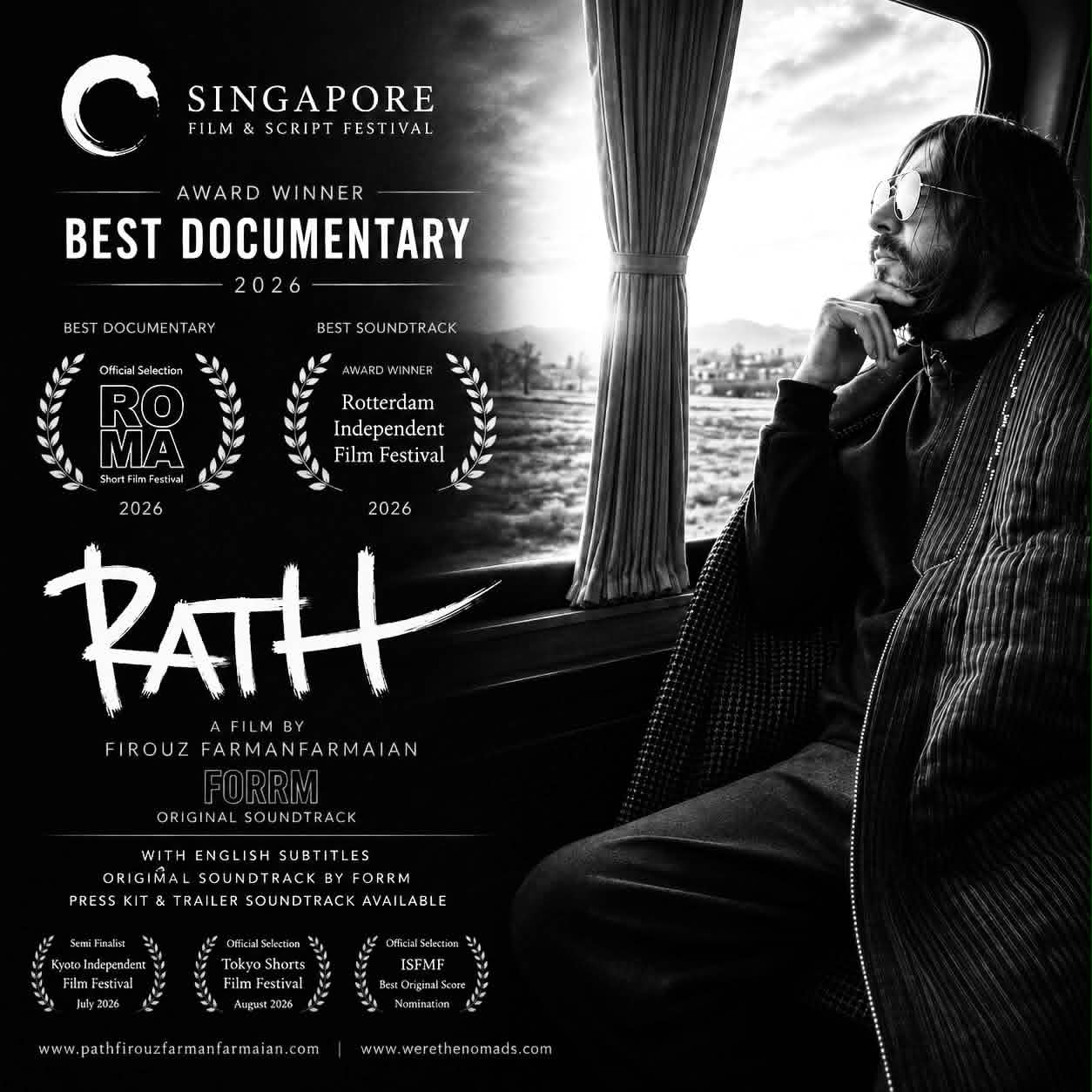
Since its completion, PATH has received international recognition across Europe and Asia, including wins in Rome and Rotterdam and, most recently, Singapore. That momentum is now opening another chapter, with international distribution conversations developing across Europe, Asia and the United States.
For me, seeing a project travel from Central Asia to an installation in Venice, and from there into an independent film with its own international trajectory, is perhaps the most exciting expression of what PATH was about in the first place.
-Which director inspires you the most?
It changes with different periods of my life. In my first films in the late 1990s, when I was working extensively with Super 8 and in a much more avant-garde language, Cassavetes and Godard were probably my two strongest references. They represented a certain freedom — the possibility of breaking the rules and allowing cinema to remain raw and instinctive.
Later, Tarantino, Wong Kar-wai and Jafar Panahi became important in developing the kind of East-West visual language I was searching for — something that could move freely between different cinematic cultures without necessarily belonging entirely to either.
But if I return to the roots, Fellini remains fundamental for his poetic approach to cinema, alongside Antonioni — particularly the Antonioni of Blow-Up and Zabriskie Point.
Interestingly, those influences are very present again today as I prepare my next feature after PATH, Season of the Witch, which we are shooting in Morocco this winter. Fellini’s poetic freedom and Antonioni’s relationship to image, space, youth and the cultural transformations of the late 1960s are very much in dialogue with the film I am making now.
So I don’t think I have one definitive influence. Cinema has accompanied different phases of my life, and the filmmakers I return to tend to change with the films I need to make.
-What do you dislike about the world and what would you change?
What troubles me is that we live in an extraordinarily interconnected world, yet we seem increasingly obsessed with separation — borders, nationalities, ideologies, fixed definitions of identity. I have always experienced identity as something fluid, something that travels, transforms and absorbs.
For me, the sparks happen precisely in the interaction between cultures. Wherever that tension and exchange exist, that is where the real avant-garde lies, whether we want it or not.
I was discussing this recently with a New York gallerist: the cultural scene is no longer as city-centric as it once was — New York in the Basquiat era, or Paris before the Second World War. Culture has become horizontal. The most interesting scene can emerge anywhere, at any moment, wherever different worlds collide and create something new.
My greater anxiety is that our lack of communication is preventing us from confronting threats that can only be addressed collectively. Climate change is perhaps the most obvious one. We have created an interconnected planet without necessarily learning how to act as an interconnected civilization.
The planet is on fire, guys. At some point we have to learn to talk to one another.
-How do you imagine cinema in 100 years?
I’ve been very interested for years in the evolution of mixed reality. I’ve experimented with successive generations of Oculus, tested Apple’s mixed-reality systems, and followed the way companies such as Meta and Ray-Ban are beginning to integrate technology much more invisibly into everyday objects. Obviously, we’re not there yet.
But I’ve always wanted to work at that juncture. There is an extraordinarily creative territory somewhere in the interconnectedness between technology and physical reality. I already tried to develop an experimental mixed-reality component for Gates of Turan at the Venice Biennale in 2022, but perhaps I was a little early, and ultimately we didn’t have the time or resources to take it where I wanted.
I believe that at some point technology will become increasingly immaterial — almost disappearing into our everyday environment. When that happens, our perception of storytelling will inevitably change with it. We may move much more fluidly between content and reality, rather than experiencing cinema as something contained within a screen.
So in 100 years, I’m not sure cinema will still be something we simply “watch.” It may become something we enter, inhabit and interact with, while still retaining what has always mattered: imagination, emotion and storytelling.
As Rimbaud said: “Il faut être absolument moderne.” Be absolutely modern — and keep your eyes open.
-What is your impression of WILD FILMMAKER?
This interview is actually my first direct encounter with WILD FILMMAKER, so I’m discovering the platform through this conversation.
What immediately interests me is its international perspective and its focus on independent filmmaking. Today, films need spaces that allow them to circulate beyond festivals, national borders and traditional industry structures.
That feels particularly relevant to me at this moment, as PATH is moving from its international festival journey into a new phase of distribution and reaching new audiences. Any platform that helps create bridges between independent filmmakers, audiences and the wider international film community is something I’m very happy to engage with.