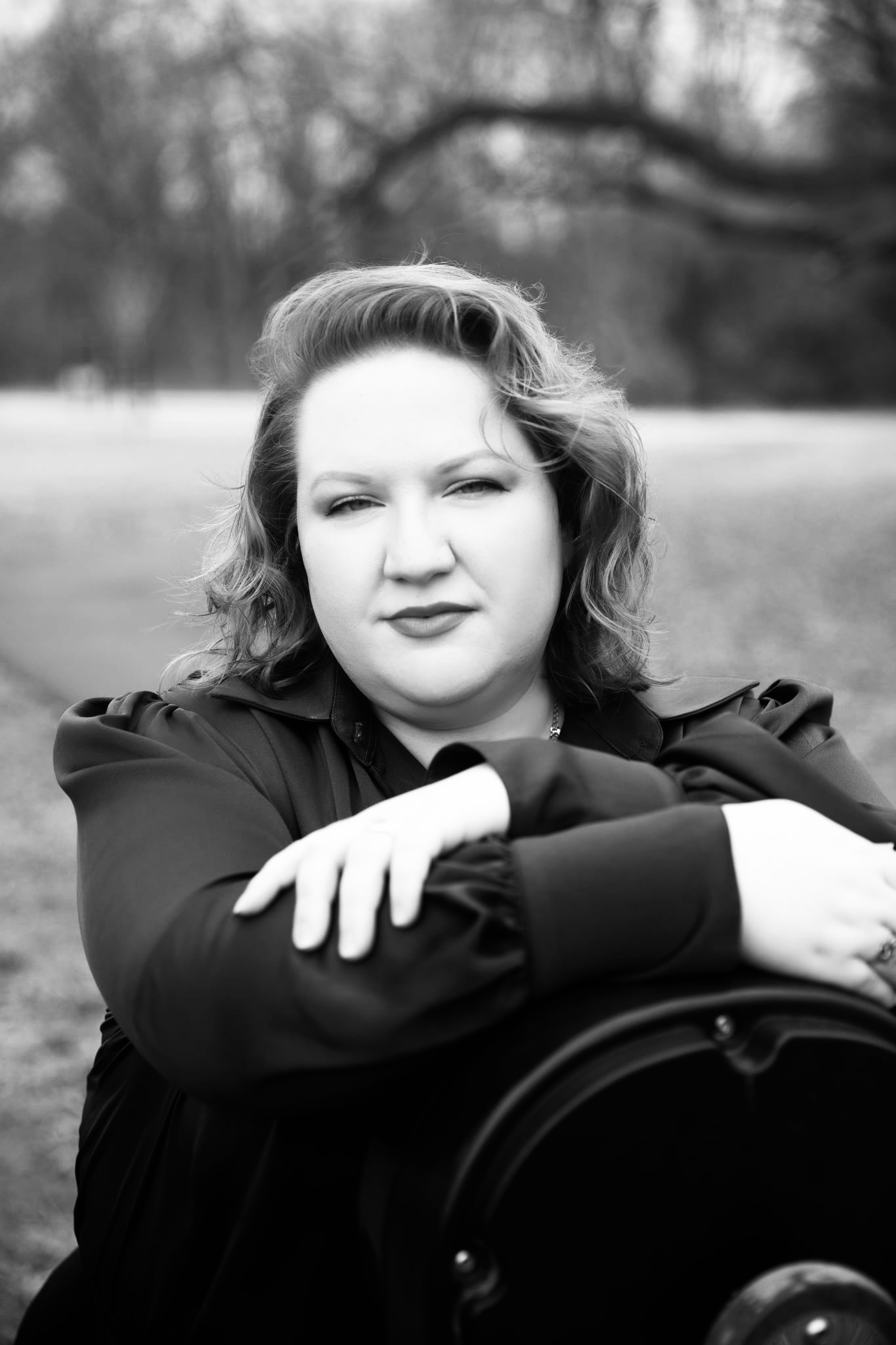
-Who is Natasha Zoë Dean?
I’m a storyteller at heart, and I think I always have been. As a child, I had an extraordinarily vivid imagination, and that imagination has carried into adulthood, permeating my creative life to this day. I was a rather lonely child growing up, with very few friends, so movies became much more than entertainment to me. They became entire worlds I could escape into, and the
characters who inhabited them became my friends. I suppose I never really stopped living inside stories. I simply grew up and discovered that, through acting, writing, and directing, I could bring some of those imagined worlds into existence.
Outside of filmmaking, I’m a singer, an Anglophile, and a lover of music, movie nights, autumn evenings, Victorian fashion, and the little rituals that make life beautiful. I love wearing vintage perfume, cooking wonderful meals for people I care about, experiencing the fragrance of scented candles as it fills a room, and watching candlelight dance across the walls in the dark.
I’m a rather theatrical person with a slightly old-fashioned sensibility, an irreverent sense of humor, and a tremendous appreciation for the unusual. At my core, I think I’m still that little girl who found friendship, adventure, and belonging in the worlds she saw
on screen. The difference is that now I have the privilege of creating worlds of my own.
-Do you remember the exact moment you fell in love with cinema?
Oh, absolutely! I was about two or three years old, and I was spending my very first night at my grandparents’ house.
My grandparents had actually been collecting VHS tapes of films they wanted to introduce me to since before I was born. That evening, they decided to show me Walt Disney’s Pinocchio.
I. Was. BESOTTED.
Not only with Pinocchio himself, but with the film and the extraordinary world he inhabited. My grandfather actually captured footage of me standing directly in front of the television, pressing my little nose against the screen because I genuinely believed that if I could get close enough, I might somehow be able to climb inside. And oh, how desperately I wanted to!
When the film ended, I cried. I was absolutely inconsolable! My grandparents eventually discovered that the only way to settle me was to play it again. And again. And again!
From that moment onward, whenever I visited my grandparents, the television was almost always on, and there was usually something wonderful playing. My grandparents practically raised me from the ages of five to sixteen, and during those years, my grandmother gave me what I can only describe as an extraordinary education in classic cinema.
Because of my grandmother, I grew up with Roddy McDowall, Natalie Wood, Danny Kaye, Gene Kelly, Bette Davis, Errol Flynn, Vincent Price, Olivia de Havilland, Rock Hudson, Eva Marie Saint, Hayley Mills, Jimmy Durante, Shirley Temple, Jimmy Stewart, Agnes Moorehead, Maggie Smith, Michael Caine, Elizabeth Taylor, Angela Lansbury, Judi Dench, Patrick Stewart, Ian McKellen, and so many others. And when I went home, my father was usually watching John Wayne or Cary Grant!
I say I grew up with these actors quite deliberately. To that lonely little girl, they weren’t simply faces on a screen. They were my friends, and in many ways, they felt like family. Even now, I still think of them that way. Looking back, I realize how fortunate I was to have been introduced to such an extraordinary wealth of cinema at such a young age. Those films shaped my imagination, my artistic sensibilities, and ultimately, the woman and filmmaker I would become.
Cinema was always the high point of my life. It was a constant source of happiness, companionship, wonder, and adventure.
There are many things about my life I wish had been different, but that isn’t one of them. I’ll always be grateful to my grandparents for giving me that gift.
-Tell us about your short film “The Bloodline: Ascension of Seraphim”.
The Bloodline: Ascension of Seraphim is a 21-minute proof-of-concept short film for a much larger feature-length story that I’ve been developing. The short serves as an introduction to the world of The Bloodline, offering audiences a glimpse into its atmosphere, characters, and the psychological horror at the heart of the narrative. It’s the story of a woman who has spent her entire life completely unaware that she is a prisoner within a high control religious environment. Her supposed “sins,” the very things that have condemned her to this existence, are circumstances over which she has absolutely no control. Yet she has been taught that they have damned her all the same. Her world is infantilizing, suffocating, insular, and wholly demanding. It requires her obedience, her submission, her unquestioning faith. It demands her soul, and ultimately, her autonomy.
At its heart, The Bloodline is the story of a woman experiencing an earth-shattering spiritual awakening. The resultant feral scream that rises within her when she finally reaches her breaking point is a sound that survivors of high-control religious environments know all too well. But beyond Seraphim’s individual story, The Bloodline is a warning. It’s a reminder that sometimes, nature’s most dangerous creatures are also its most beautiful. I think of The Bloodline as the poison dart frog of cinema. It’s beautiful. You’re fascinated by it. You want to touch it, perhaps even take it home.
But once it’s in your hand…
It’s already too late.
-Which director inspires you the most?
Oh, that’s a difficult one because there are two directors who have had an enormous influence on me, but in very different ways.
Alfred Hitchcock is probably the director who has influenced me most artistically. His mastery of visual storytelling, atmosphere, suspense, and psychological tension absolutely fascinates me. I remember watching Vertigo and being completely floored by what he accomplished cinematically. Even now, I find myself watching his work and thinking, “I WANT TO DO THAT!”
And then there’s Notorious, which has taken up permanent residence in my psyche and occasionally wanders into the kitchen to ask whether I can spare a cup of coffee and a cigarette because Cary Grant has just nicked the last one.
But the director who actually changed my life was Robert Rodriguez. Before I made my short film EXIT, I read his book Rebel Without a Crew, and it completely revolutionized the way I thought about filmmaking.
What astonished me was how closely his approach to filmmaking mirrored the way I’d approached creative projects throughout my own life. His resourcefulness, his willingness to experiment, and his determination to make something extraordinary with whatever he had available resonated with me tremendously. As a teenager, before I had access to laptop editing programs, I used to edit videos by connecting two VHS recording machines together, playing footage on one and recording my edits onto the other. It’s a painstaking process that requires an extraordinary amount of patience and precision! So when I read that Rodriguez had used the same technique to edit his early short films, and that he’d gone on to make El Mariachi using similarly resourceful filmmaking methods, I was absolutely floored.
Here was a filmmaker who understood that creativity and ingenuity could accomplish things that money alone couldn’t. And he’d proven it by making an entire feature film on a shoestring budget. It was completely exhilarating to discover that someone whose approach to filmmaking so closely resembled my own had actually succeeded in Hollywood.
Rodriguez helped me understand that I didn’t need an enormous budget, expensive equipment, or an army of people to begin making films. I could simply begin. And that’s exactly what I did.
My earliest filmmaking efforts were accomplished with virtually nothing. No professional lighting, no crew, no elaborate equipment, and sometimes no actors other than myself. I wrote, directed, performed, filmed, and edited whatever I could manage with the resources available to me. It was guerrilla filmmaking in its purest form, and I loved it.
Robert Rodriguez didn’t just inspire me creatively. He gave me the confidence to believe that I could make films regardless of my circumstances. If I ever had the opportunity to work with him, I think I might actually evaporate with glee.
The man is a legend.
-What do you dislike about the world and what would you change?
How much time have you got? ☺
But seriously, if there’s one thing I dislike most about the world, it’s humanity’s seemingly endless inability to learn from its mistakes. We repeat the same destructive patterns ad nauseam, generation after generation, and then stand back, survey
the absolute mess we’ve made, and go, “Huh. I wonder how THAT got there?” It’s maddening!
If humanity could just learn something from its history, be kind to one another, and stop making absolutely everything about money and power, perhaps we’d be in a better place.
And for the love of all things sacred, could we PLEASE stop bloody killing each other?! I think there’s a difference between people who lack compassion and those who know perfectly well how to be compassionate but choose power or self-interest instead. I find that particularly troubling within certain religious and political institutions, where I don’t believe that choice is always accidental.
And don’t even get me STARTED on medical misogyny! Women can spend months having their symptoms dismissed as anxiety, only to discover something seriously wrong. Then the doctor suddenly shrieks, “GOOD HEAVENS, JANET! YOU HAVE A TUMOR?! HOW DID THAT GET THERE?!”
Well, perhaps if somebody had LISTENED TO JANET nine months ago, we wouldn’t be having this conversation!
Makes my blood boil. But if I explain further, we’ll be here till Christmas 2048.
Ultimately, I wish we’d stop treating kindness as something expendable whenever it becomes inconvenient. We have an extraordinary capacity to learn, love, create, and care for one another. I just wish we’d make better use of it.
Oops… that was three things I dislike about the world, wasn’t it?
-How do you imagine cinema in 100 years?
I think performance capture and independent filmmaking are the future of cinema. What Andy Serkis has been doing with performance-capture technology is revolutionary, and I think it’s absolutely wonderful! The possibilities for bringing films, theatre, and video games to life in ways we’ve never experienced before are extraordinary, especially when you consider the advances in virtual reality and immersive entertainment.
Imagine walking into a cinema in 2126 and discovering that the film isn’t simply playing on a screen in front of you. It’s ALL AROUND YOU. The entire theatre becomes part of the story. The characters move around you, the world feels completely real, and suddenly you’re not just watching the film anymore.
You’re IN it!
Perhaps films will become interactive, almost like video games. Perhaps we’ll have something resembling the Holodeck from Star Trek: The Next Generation! Gods, I’d never leave! As a little girl, I used to press my nose against the television because I esperately wantedto climb inside the movies. Imagine if that actually became possible!
But I also believe independent filmmaking is going to play an enormous role in the rebirth of Hollywood and cinema as a whole.
I think the traditional studio system, as we’ve known it, is becoming increasingly unsustainable. We’re having to rethink how films are financed, produced, and distributed, and in some ways, start rebuilding the industry from the ground up.
And don’t misunderstand me, I don’t necessarily think that’s a bad thing! It gives me HOPE.
Independent filmmaking is about creative freedom. It’s about embracing storytelling as an art form and giving filmmakers the opportunity to tell stories that might never have found a home within the traditional studio system.
But whatever technological wonders await us, I sincerely hope movie theatres still exist in 2126. There’s something magical about sitting in a darkened theatre, surrounded by strangers, and sharing the experience of a wonderful film. Cinemas are part of the very foundation of our history as filmmakers, and Hollywood wouldn’t exist as we know it without them.
So whatever cinema looks like in a hundred years, I hope the theatres are still there.
-What is your impression of WILD FILMMAKER?
I’ve only recently been introduced to WILD FILMMAKER, but I really appreciate what they’re doing! I love that they’re creating opportunities for filmmakers to connect with the industry on an international scale. I think filmmaking should always be about collaboration, community, and bringing creative minds together, regardless of where they happen to be in the world.
It means a great deal to me that they’re giving independent filmmakers like myself an opportunity to share our stories and creative visions with a wider audience. Visibility is so important in independent cinema, and having a platform where our work can be discovered, appreciated, and celebrated is a wonderful thing. I’m genuinely grateful for the opportunity to be part of that community and to share a little of my own journey
with their readers.