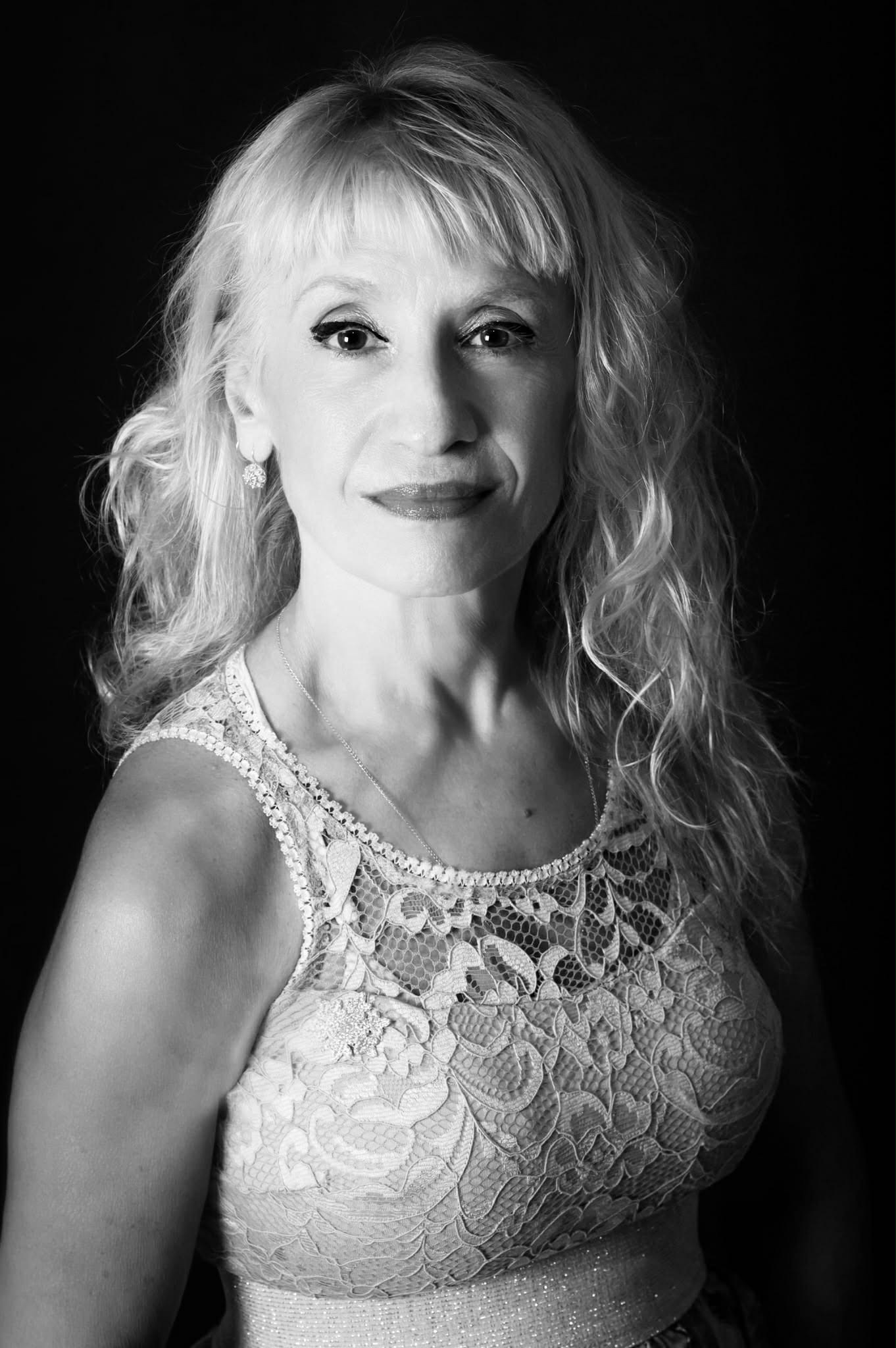
I am 71 years old, a successful person who has always achieved what I set my mind to. I regret nothing about my past. I have many projects that I will not be able to complete… IT DOESN’T MATTER!… I will leave it to my grandchildren to continue along my path, just as I did with my parents. If you haven’t figured it out, I have a very high EGO… why pretend to be modest?!
The time I have left is short, and it is the most earthly thing closest to God—something science has not managed to control. This does not trouble me; on the contrary, the idea that my SCRIPTS might be read, perhaps even produced, fills me with pride in the eyes of my grandchildren, almost as if it were extending my life.
I recall Ray Bradbury’s story Fahrenheit 451 (directed by François Truffaut), where books were banned and burned, and a group of people memorized them to pass them on to future generations.
“I WANTED!… AND I ALWAYS WANTED!… AND I STRONGLY WANTED!” is a quote from Alfieri that has always guided me in life.
To your question: “Who is Giampietro Manzalini?” I reply with my website (https://sites.google.com/view/giampietro-manzalini-eng/home), where you will find many answers. I believe the MOVIES section deserves your attention. All my scripts are available on the FilmFreeway portal.
Historical action story (1919–1922). It recounts the birth of Agrarian Fascism in Ferrara, up to—but not including—the March on Rome, with the abuses of the Socialist Leagues as accomplices.
A historical account of the rise and fall of the Savonarolan Republic in Florence (1490–1498), from the expulsion of the Medici while Rodrigo Llançol de Borja ascends “ad limina Petri,” driven by nepotism and corruption within the Roman Church, leading the Dominican friar to the gallows and his remains to the stake. Savonarola was a precursor of Martin Luther’s Reformation.
Historical drama (1416–1425) set at the court of Niccolò III d’Este, where 14-year-old Parisina Malatesta, his wife, after a period of mutual antipathy with Ugo—his illegitimate son—complicit with the plague, fall into a passionate love affair that leads them both to be beheaded.
Do not think I am doing all this for money—quite the opposite.
I am willing to grant one (of your choice) of my SCRIPTS free of charge under the following conditions:
Within six years, it must be screened at least 1,000 times (note that there are over 50,000 screens across the EU + USA + UK + AUS).
Upon signing the contract, I must receive a guarantee from a leading Italian bank, expiring at the end of the sixth year, in the amount of €300,000.00—payable only if the film is not screened.
Jurisdiction: FERRARA (Italy).
2 – Do you remember the moment you fell in love with Cinema?
Around the age of 18, when I learned lighting techniques and discovered photography, of which I am a good connoisseur. At the time, we used film cameras; we spoke of ASA, DIN, developers, fixers. I printed in black and white with decent success, even in national photography competitions.
I would spend nights watching silent films, appreciating actors and directors who are still worth watching today.
I have retained a certain bias: I watch movies critically, especially the lighting, the choice of framing, and the development of the plot.
3 – Tell us about GIROLAMO SAVONAROLA & The Trial of Fire.
It would be unthinkable to compare myself to these pillars of world cinema, but they are the first who come to mind—surely I forget many others.
I appreciate directors such as R. Polanski, Q. Tarantino, D. Lynch, J. Schumacher, J.-J. Annaud, F. Vancini, G. Salvatores, M. Bellocchio, M. Soldati, O. Welles, B. Wilder, A. Hitchcock, F. F. Coppola, F. Fellini, and others.
5 – What do you dislike about the world, and what would you change?
Wow… what a challenging question!!!… Off the top of my head, I would say we should follow more closely these two teachings of Our Lord:
Love and fear the Lord.
Respect others as yourself.
6 – How do you imagine Cinema in 100 years?
I cannot imagine it!
When I was a child, my father was amazed when he heard that in the USA cars were destroyed after use. Then came television, we went to the moon, we transmit wirelessly… all within 70 years… who knows in 10 years?!… perhaps televisions will emit smells, people and goods will move via teleportation… I will sleep at home, have breakfast in New York, and return home in the evening.
7 – What impression do you have of WILD FILMMAKER?
I am a newcomer to the field, so I do not know you yet… but you are welcome. I am open-minded and multifaceted.
When I was young, I used to ask myself: “What does Peyman Majidi want? What does he intend to do?” Driven by these questions, I started working at the age of seventeen. Over the course of seven years, I tried nearly thirty different jobs, only to leave them one by one—insignificant and futile occupations in a world of the dead. Everything changed the night I saw The Marriage of Mr. Mississippi on a stage in Tehran; that was when I realized what I truly wanted. Suddenly, everything became clear and meaningful to me. I believe art is a means to rise and attain freedom. I pursued my education in Dramatic Literature at university, where I met Sabina Shiari. We got married, and I began my journey as a writer. My writing is an attempt to set myself free. She is an extraordinary woman, a brilliant collaborator, and a wonderful partner. Together, we strive for our independence and search for a path to liberation, constantly experimenting with various forms and expressions of art.
Do you remember the exact moment you fell in love with cinema?
Watching a film is an act of revelation—as profound as it is perilous. It feels as though a shaman is showing you a vision or speaking a truth that upends and utterly transforms your life. In my youth, I watched Alan Parker’s The Wall with obsessive precision, once or twice every single day for nearly two years. I was like a prisoner in solitary confinement, clutching a yellowed, tattered scrap of newspaper hidden beneath his mattress, reading it over and over again. I cherished it deeply. However, the film that was destined to possess my soul once and for all—the true answer to your question—was Angelopoulos’s The Suspended Step of the Stork. I returned to the cinema to watch it for a long time. At that time, Iran was at war with Iraq; films on the big screen were rarely changed and would sometimes remain in theaters for months. I vividly remember the empty cinema and the desolate, darkened streets through which I would walk home. In those moments, cinema was truly like a beautiful mistress in my imagination; I was profoundly in love with it.
Tell us about your project “Faust – This Had Never Happened OR Resurrection of Angels with Broken Wings”.
It was born out of the pandemic! At that time, I hadn’t imagined returning to cinema for years; it felt like an unreachable horizon. In truth, I had written a stage adaptation of Goethe’s Faust, and we were in the midst of pre-production for the theater when the COVID-19 lockdowns hit. Suddenly, we were confined to our homes. Our only lifeline to the cast and crew was through video calls and online rehearsals. Then, one night, an idea struck me: why not transform this into a film? I proposed the idea to Sabina—we are the co-directors and producers of this project. She was initially shocked and asked for time to deliberate, but a few days later, she accepted. When we shared the vision with the rest of the team, everyone was on board. My reasoning was that Faust possesses immense cinematic potential. It promised to be a profound independent experience—a journey where we would transition from the stage to the screen, unlearning and relearning everything from scratch. Following that decision, we spent a year in rehearsals, followed by an intense seven-day shoot to complete the production phase. Our film is a Dadaist and, specifically, a dreamlike adaptation of Goethe’s Faust. In the world of this film, we deal with dreams that are disjointed, fragmented, and assembled like a collage. The visible reality within these dreams is intentionally fabricated and artificial—it is not magic. One must seek and comprehend the meaning of these dreams beyond what is merely seen. Consequently, the narrative and every element of the film were influenced by, and designed around, this very concept. For instance, we pIt is as if you are witnessing a scene in a dream without even blinking; everything unfolds before your eyes without traditional cutting, or it leaps abruptly from one image to another, yet you perceive it all as real. What we convey—and indeed, what we warn the audience—is that this is a dream. In a concise and complete sense, the film is an experiment in translating Goethe’s Faust into the language of dreams. It stems from the premise that we first experience a dream where everything is fabricated, and it is only through its cracks and fissures that fragments of reality can be glimpsed. Goethe’s Faust consists of two volumes. In the first, an aging Faust sells his soul to Mephisto to regain his youth. In our adaptation—which draws more heavily from the second volume—the young Faust and the old Faust coexist simultaneously. In essence, Faust has become cloven, torn between two halves in a state of intense conflict. The young Faust is an urban architect and an anarchist, driven by the desire to build a “terrestrial paradise,” while the old Faust is a hedonist in search of pleasure and youth. Beneath this surface lies the struggle between tradition and modernity—a war between the old world and new ideals. Then, there is the third force: Mephisto, representing the oppressive apparatus of power and capital. We extended this “dream logic” into every facet of the film—visuals, sound, music, architecture, and costume design. We intentionally disrupted costume continuity to maintain the dreamlike instability. In our lighting, we explored the recurring motif spoken by Mephisto: “Darkness shines like the day.” For instance, to depict an eclipse and provoke a sense of unease, we filmed exterior night scenes in natural daylight. This serves as a reminder that the reality we perceive is something fake and manipulated—an unnatural desire born from a malignant will. The sound design and effects followed a similar philosophy, signaling that the reality of this world is a deception. We utilized the sounds of storms and rain where no rain was visible, or the surreal auditory experience of a piano being played upon a violin…
Which Director inspires you the most?
To answer this question, I could look to the extensive list I hold in my mind—from Fellini, Buñuel, and Pasolini to Lynch and Tarantino, or perhaps von Trier and Lanthimos. I have learned so much from all of them; I deeply admire and love their cinema. However, there is one director whose work remains, for me, eternally peerless—a definitive benchmark. He is a master who could tackle any genre with absolute perfection. His obsession and precision were boundless, and his films are infinitely maddening, visceral, and profound: Stanley Kubrick.
What do you dislike about the world, and what would you change?
I believe nothing in this world is more abhorrent than tyranny and ignorance, and no struggle is greater than the fight for freedom and awareness. I stand against the misguided notion that for an individual— and specifically for an artist—taking responsibility and gaining awareness only leads to suffering. On the contrary, I believe both are essential and transformative; they are the catalysts for growth and transcendence. Without accepting responsibility, we lack the will to change or evolve, and without awareness, we can never make a truly right decision. Oppression and fossilized thinking strip life and art of their meaning—and a world void of meaning is a desolate and degrading place.
How do you imagine cinema in 100 years?
A century from now, we will still be on the path we travel today: the path of evolution. And for evolution to occur, change is inevitable. Whether these changes—this shedding of old skins—happen through conscious choice and control, or through unpredictable events and revolutions, they are unstoppable. In this journey, cinema remains one of our most vital tools for exploring and experiencing the profound depths of the human condition. I believe that cinema will make monumental leaps in technology and technique, which will undoubtedly allow for the creation of captivating fantasies. Ultimately, however, the “Seventh Art” must commit to a process of rebirth and renewal. It is destined to become more contemplative, more inquisitive, and, above all, more honest.
What is your impression of WILD FILMMAKER?
I believe you have an exceptional and avant-garde publication that provides a comprehensive and profound reflection of contemporary cinema. Moreover, your magazine’s dedication to artistic and contemplative cinema is truly commendable; it is this very focus that lends prestige to the medium of film and commands my utmost respect. I am deeply grateful for the opportunity you have provided me and for this meaningful conversation. I sincerely wish you continued success.
I am a filmmaker from Ontario, Canada primarily operating within the tradition of underground film. All of my movies are made with no-or low- budget and with a guerilla, DIY sensibility. To put it simply, at the current moment Thomas Dimopoulos is a free thinking, experimental and skeptical orb of consciousness using the cinematic art as well as other mediums as a way to subvert expectations and use cognitive dissonance in order to unlock new forms of thought inside of people, make them question, and hopefully make them laugh.
-Do you remember the exact moment you fell in love with cinema?
There are many moments to choose from, as I have been making projects ever since I was four years old, when I started making stop motion projects. An early memory for me is when I was eight years old and discovered my father’s collection of Alfred Hitchcock films on DVD. I was drawn to “The Birds”, and remember first seeing that particular film as a pivotal moment for me. It also ignited my passion for exploring Hitchcock’s work .
Of course, another early moment of my love for cinema was seeing the Chaplin films as a younger child. “The Gold Rush” stands out as an example for me, though I believe “City Lights” is his most powerful work. Furthermore, I have great memories of watching many classic Hollywood Western films with my grandfather, such as “The Fastest Gun Alive”, “The Man Who Shot Liberty Vallence”, “Shane”, and most importantly “High Noon”. I have probably seen “High Noon” with my grandfather a dozen times, and it remains one of my favourite films.
Those were some instances of me falling in love with more ‘conventional’ cinema.
However, the possibilities of film expand well out of the realm of what is ‘conventional’, and there are a couple of moments I can think of where I fell in love with this new type of movie. My first time seeing Kubrick’s “2001: A Space Odyssey” when I was eight years old in my family’s living room was a seriously important moment for me. It wasn’t until I was about thirteen when I started really discovering more experimental or underground film. I remember watching Guy Maddin’s “My Winnipeg” with my dad, discovering Nick Zedd’s underground masterpiece “They Eat Scum”, and first seeing Stan Brakhage’s “Dog Star Man” as being pivotal moments for me.
-Tell us about your project.
I have many different projects I have done over the past many years. An endeavor within the past year was putting together a DVD compilation of my work, entitled “The Short Movies of Thomas Dimopoulos Vol. 1”. This compilation includes a good handful of my work, featuring “Pop Goes The Weasel!” (2024), “Big Ronda’s Ointment Surprise!” (2024), “Texas Roadside Pigs!” (2024), “Miss Rabbit & the Devil!” (2024), and “Flower Rat” (2025).I have since done additional films as well.
“Pop Goes The Weasel!” is a 10 minute examination of a group of obsessive homeless people living in/around a construction site. The project came to fruition when my uncle approached me at Christmas dinner 2023 telling me that he was interested in acting in one of my movies (I had recently just released “Why Go Left When You Can Go Right?”). I left the dinner and went down to the basement with a napkin and a sharpie where I started the script, envisioning my uncle as a homeless man dragging a wrench, which he considers his pet, around on a leash, and wearing cat ears. Once I got that baseline for the work done, the other visions started coming to me (e.g., the demon boy who wishes he was a house, the shadow boxer befriending a child’s doll, etc).
“Big Ronda’s Ointment Surprise!” started as a title before anything else. I liked the ring to it. From there, I made it into a song, and characters started to emerge from that. I became highly intrigued with the idea of ointment obsession and really just went from there. I had a pretty loose script and shot the movie in just one afternoon with my aunt being perfect to play the titular character. I was shooting that movie pretty vibe based. It was my notion of a surrealist comedy.
“Texas Roadside Pigs!” originated as a phrase I made up and became obsessed with using (“it’s hotter than a texas roadside pig outside!”). Eventually I started thinking about what such a thing would look like, and envisioning people dressed up as pigs lying on the sides of roads. Once this image came into my head, I could not get rid of it. I convinced some friends (longtime collaborators Ben Ford and Jiggilin’ Hinzman, who really are good sports) to star in the film, and I ended up being very happy with their performances. “Texas Roadside Pigs!” was made in a different way to my other films, in that it is the only one of my works that I storyboarded. I felt that to most impactfully convey the essence of what I wanted, storyboarding was important. As I shoot my work guerilla style, this film in particular I got into some trouble filming. I was shooting behind a retirement home, and security was called and escorted me off the premises.
“Miss Rabbit & the Devil!” was a total departure from the other works thus far in that it was more personal. I play every role in the film, and it was really more of an experiment in hallucinations rather than having character or story. I enjoyed playing around with colour, as well as using strobe lights in order to have the viewer experience an altered state of awareness.
“flower rat” was probably the most fun of my movies to make, despite it maybe being the darkest. I shot the film at a Halloween trail, starring a homeless woman who had tremendous acting talents. She was very easy to direct, got my vision and most of her work in the film was improvisational. When I was editing it, I turned the film into a comment on the culture, as I added in footage that I was seeing in the news.
“Teenage Pregnant Clown!” also started as a phrase that I became enamoured with. Overall, it is my idea of a more straightforward comedy without the straightforward part. Similar to my other work, I just started thinking about a pregnant clown who is a teenager, smoking cigars and having conversations with a tree. This film was a lot of fun to shoot. Many people tell me it’s their favourite of my work and for that, I am very pleased.
“Crushed Cats” is one of my favourite of my films, and I feel that it is also one of my most politically explicit works. The film utilizes a lot of found footage of things I saw on the news, including body camera footage as well as archival interviews with Charles Manson. The work is an extremist, comedic, political film about authoritarianism. I play a little cat boy. I don’t think there is anything else I should write about this film as the best way to experience it is to watch it.
I am now in the process of doing a film called “Playful Planet” which is less concerned with character, and more interested in colour, vibration, and frequency. It features narration from the filmmaker Wigwolf, who is a good friend of mine.
-Which Director inspires you the most?
Many directors inspire me for different reasons. One of the directors who inspires me the most is the underground filmmaker and creator of the Cinema of Transgression, Nick Zedd. He consistently made both shorts and features in an uncompromising and raw way, and his do-it-yourself ethos resonates greatly with me. He proved that the only thing you need to make a good movie is a good mind. In fact, I have the pleasure of now being close friends with his widow, Monica Casanova, who I am working with in the Nick Zedd archive. Her and I have a lot of exciting things coming up!
The filmmaker Giuseppe Andrews also serves as a big inspiration to me. The fact that he made over 30 features with little to no money living and shooting in a trailer park, has and will continue to inspire me and my work. I think both he and Nick are true artists.
-What do you dislike about the world and what would you change?
I dislike a lot about the world and there is a lot I would like to change. However, what I and my work are most concerned about now is the continuously increasing gap between the ultra wealthy and the rest of humanity. We are now living in a time where, according to a statistic by Oxfam, the top 1% have more overall wealth than the bottom 95% of the global population. I consider this to be an important statistic showcasing the immensity of human greed.
I also find myself having problems with the corporatization of our planet and fear that in the years to come the world may be run by a series of large corporations, partially operating through the exploitation of labourers, for their continuous profits. I am concerned about the continuing use of child labor amongst many large corporations. These are things I hope to discuss in my future work. Similarly, I dislike that by the year 2050 it is projected that there will be more plastic in the ocean than fish (by weight). It is evident that our current system has nearly single-handedly destroyed the planet earth and if we wish to keep reproducing on this planet, something must be changed immediately. I fear that in 100 years it is entirely possible that clean air will be taxed by the corporate government elite.
-How do you imagine cinema in 100 years?
I am excited to think about where cinema will end up in 100 years. I hope that cinema is still alive and flourishing. I do worry about the potential for film to fall victim to total censorship by a global fascist elite with the intention of demoralizing all art. I think there will always be a couple of important individual artists working however. I ponder if in 100 years movies will go further into the realm of virtual reality and I like the idea that movies may be things that you can physically get inside. I hope cinema will be more of a transcendental experience.
-What is your impression of WILD FILMMAKER?
I really appreciate what WILD FILMMAKER is doing, showcasing the lives and works of many different artists, both those who create for the mainstream audience as well as those who do not. I enjoy reading the interviews you do and always learn new things from them, as such a vast array of filmmakers are featured!
Tell us about your latest projects presented in the Bay Area.
In my current project, I explore and shape contrasting energies that form the eroticized body, using video and photography. As a result, the viewer is taken on a subjective journey through the erotic dreamscape of the body, passing through varying streams of consciousness in pursuit of the ultimate erotic desire – the orgasm, metaphorically seen as “chasing the light.”
The video comprises several vignette videos that transcend the erotic imagination from the subconscious world of dreams into the conscious world of being. The video centers on the contradiction and paradox of the erotic experience, which brings about tension and thus finds its release through the transgression of opposing energies that clash and ignite each other into a kaleidoscope of light and color. The sounds of breathing navigate the labyrinth of the subconscious dream world, yet simultaneously, one is acutely aware of being in the present conscious world; one is lost and found, invisible and visible. The paradox of the erotic experience.
The photographic component is composed of varying stills from the film that have been manipulated and molded into submission via the subconscious and the erotic imagination, into the conscious world. Images are printed onto the surface of textured, porous paper, whereby the conscious and subconscious – the visible and the invisible – merge and enter into a state of secretion, leaving tattooed traces, or printed images, of the erotic experience.
Who inspires you when you create a work of art?
When I am in the process of creating art or filming, I often find myself deeply immersed in my own creative flow. However, before I begin, I typically listen to music and explore various artworks and films for inspiration. While working on my current project, I was listening to Björk, PJ Harvey and the slits ,as their music embodies both rawness and surrealism as well as being sexy as hell. Film wise I found myself influenced by The Innocents directed by Jack Clayton, Fellini’s 8 ½ and Antonioni’s Blow – Up. Recently, I’ve been exploring a Gothic phase, which has led me to study the works of Joel-Peter Witkin, John Everett Millais’s “Ophelia,” and the art of the German surrealist Hans Bellmer.
What is Art in 2026?
Art needs to be challenged to evolve, and the importance of technologies, such as AI, is important to its survival as we enter the second quarter of the 21st Century. However, I fear that technology may overshadow the fundamental element of all art: human consciousness and one’s subjective experience of existence.
What projects are you currently working on?
I am working on eroticism as a philosophy, in particular focusing on the spiritual element of eroticism. For example, the conscious erotic experience is absorbed into the body and connects to the unconscious components of said body, detonating a combustion that results in the orgasm. As the orgasm filters through one’s consciousness and unconscious, the soul gathers the residues of the event, such as memory and identity – the spiritual essence of a living being – and turns the experience into deep feelings of emotion. Eroticism is a cognitive conduit that channels sexual love-eros via art, into a philosophy based on lived experiences.
What’s your impression of WILD FILMMAKER, the largest community of Indie Film Producers in the world?
WILD FILMMAKER is the contemporary epitome of Neorealism, returning to the social and human roots of filmmaking. Back in the 1940s/1950s, Neo Neorealism was a film movement about making things’ real, ie, characterized by a focus on the lives of the poor and working class, a documentary-like style using real locations, non-professional actors, and a rejection of studio glamour, giving filmmaking a human face and sensitivity. WILD FILMMAKER demonstrates that everyone can be a filmmaker, whether it’s with a camera phone or a traditional camera. It opens filmmaking up to everyone, not just the elite of Hollywood and other film industry centers. Again, just like before, it takes filmmaking out of the studio and onto the streets, utilizing elements of social engagement with actors, regardless of their level of professionalism, and imbuing it with a human sensibility, where anything and everything is possible.
I recall one late summer evening in 2022, when I spoke with Michele Dioma about his idea of creating a space for all independent filmmakers. I remember his passion and unwavering commitment to bringing filmmaking back into the hands of the people, and in a short space of time, he did it. I am very proud of him and WILD FILMMAKER.
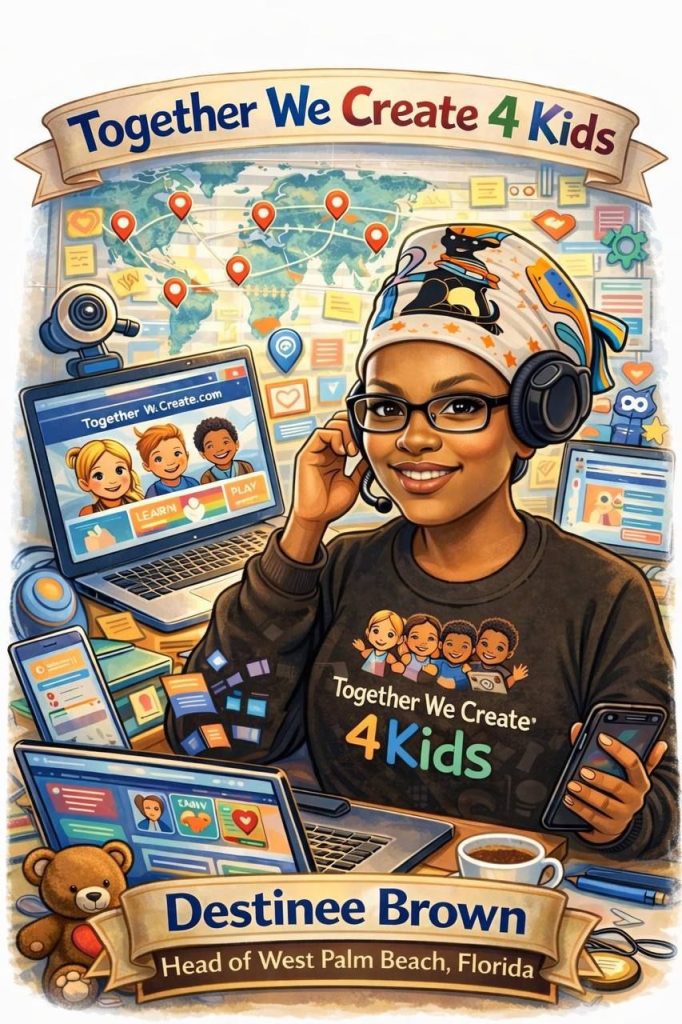
Together We Create 4 Kids is a national, multi-city literacy and community impact tour rooted in the belief that storytelling, education, and collaboration have the power to transform lives. Designed to uplift children, families, authors, educators, and purpose-driven leaders, the tour is more than a series of events it is a living movement committed to access, service, and generational change.
Each city stop is intentionally structured as a two-day experience. Day One centers on adult empowerment, featuring authors, speakers, educators, panels, workshops, and vendors who are building purpose-driven organizations and businesses. Day Two is fully dedicated to children and families through a community giveback that provides books, bookbags, clothing, shoes, hygiene products, and educational resources directly into the hands of youth.
What makes Together We Create 4 Kids unique is its ecosystem approach. Every participant authors, speakers, vendors, partners, and community leaders is viewed as a vital voice in the story.
The tour prioritizes collaboration over competition and impact over exposure, ensuring that each city contributes to a larger, connected mission rather than a one-time moment.
The Documentary: Capturing the Story as It Unfolds
Running parallel to the tour is a professionally filmed documentary series that captures the heart of Together We Create 4 Kids in real time.
The documentary is not scripted or staged. Instead, it follows the authentic journey of building a national movement documenting preparation, faith, challenges, breakthroughs, and the human stories that unfold behind the scenes.
Each city becomes an episode, highlighting:
Local leaders and organizations serving their communities
Authors, speakers, and vendors contributing their voices and resources
Children and families impacted by the giveback
The real work, emotion, and intention behind community service
The documentary serves as both a historical archive and a call to action showing what is possible when people unite around purpose, service, and shared vision.
A Platform for Legacy, Not Just Exposure
Together We Create 4 Kids was intentionally built as a platform for legacy, not a moment of visibility. Every author, speaker, vendor, nonprofit, and partner involved is treated as a contributor to a larger story one that honors purpose, service, and long-term impact over short-term attention.
Participants are given space to share who they are, why their work matters, and how their mission connects to the communities they serve. Rather than positioning individuals as background support, the tour recognizes each voice as essential. This philosophy extends across the events, the documentary, and all media connected to the project.
The platform also creates pathways for continued collaboration beyond the tour.
Relationships formed on the Together We Create 4 Kids tour are designed to live on through future projects, storytelling opportunities, and community initiatives. In this way, the tour becomes a foundation helping leaders build something that outlasts a single city, season, or spotlight.
By centering legacy, Together We Create 4 Kids ensures that the work done today carries meaning tomorrow reaching far beyond the stage and into generations to come.
Honoring the Co-Founders: The Heartbeat of the Movement
At the foundation of Together We Create 4 Kids is a group of co-founders whose leadership, character, and commitment shaped the tour long before the first city was announced. These leaders are not simply organizers they are the pillars, strategists, storytellers, and servants who ensure the mission remains rooted in integrity and love.
Dr. Laneice Runnels brings wisdom, consistency, and structure to the movement. Her leadership anchors the tour in excellence and accountability, ensuring that vision and execution remain aligned and impactful.
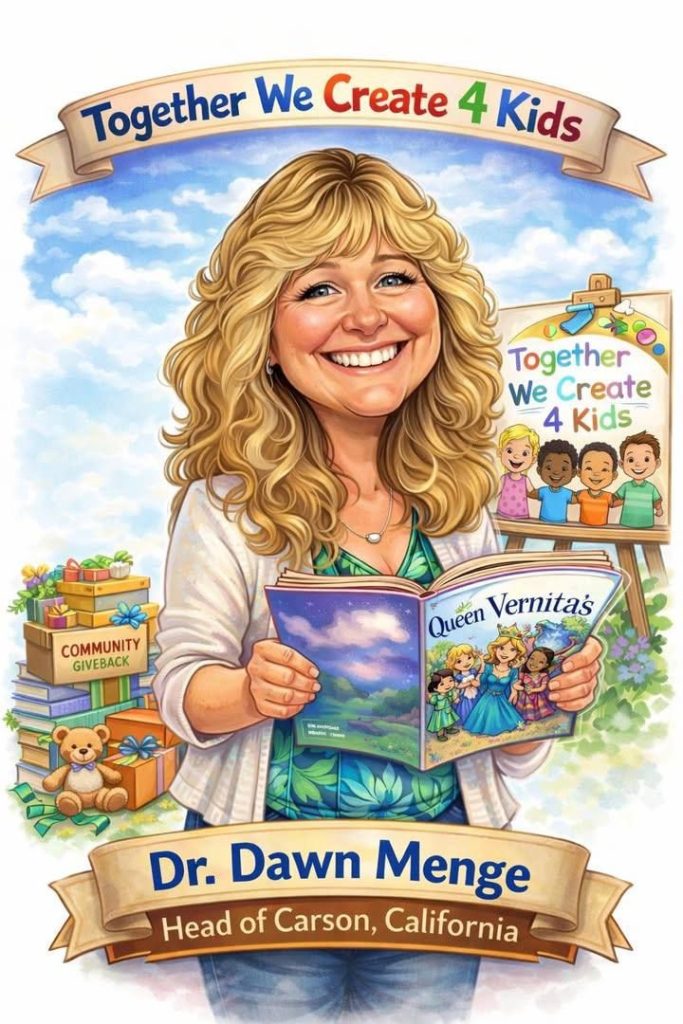
Dr. Dawn Menge represents the transformative power of storytelling. Her lifelong dedication to literacy, children, and education reinforces the belief that books can open doors, heal hearts, and create lasting change.
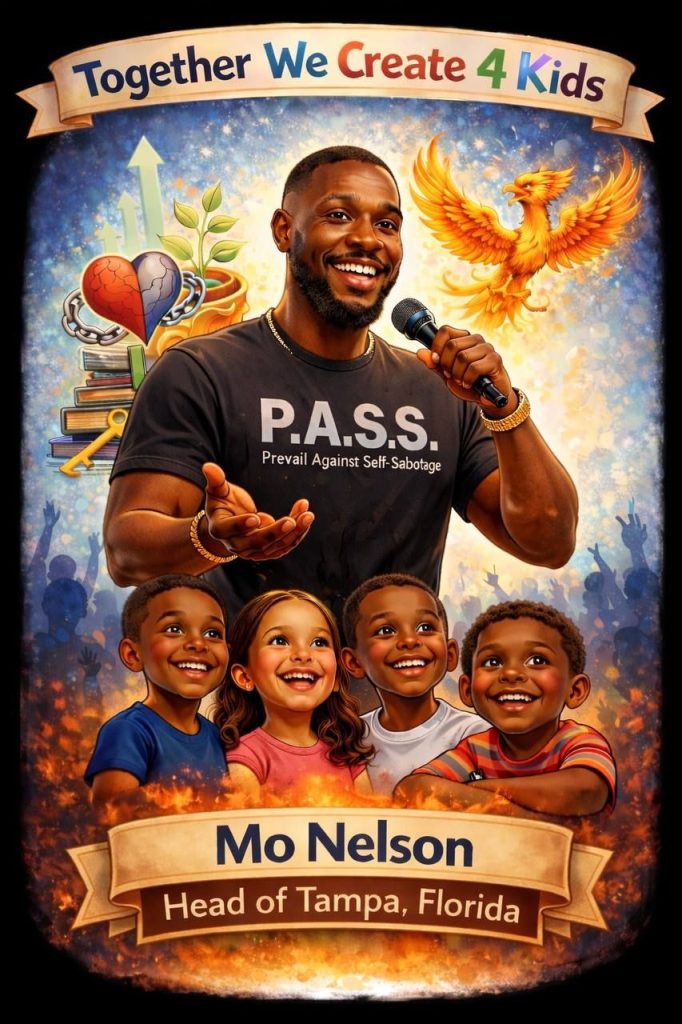
Mo Nelson, city leader, embodies authenticity, courage, and emotional intelligence. Her work centers on breaking cycles, empowering individuals, and turning self-awareness into action values deeply embedded in the tour’s purpose.
Dr. Tish Shearer offers strategic insight, faith centered leadership, and balance. She helps bridge vision with sustainability, ensuring that the tour remains both meaningful and operationally sound.
Amber Miller brings connection, compassion, and community centered leadership. Her ability to unify voices and cultivate safe, collaborative spaces strengthens the relational foundation of the movement.
Destinee Brown, visionary, is the architect behind Together We Create 4 Kids. Her belief that storytelling can create access, healing, and opportunity fuels the entire project. She designed the tour not for spotlight, but for legacy creating platforms where children, creators, and communities are seen, supported, and celebrated.
Together, these co-founders form the heartbeat of Together We Create 4 Kids. Their shared leadership ensures the movement remains grounded in purpose, faith, service, and impact proving that when the right people come together, something far greater than an event is created.
A Growing National Vision
As Together We Create 4 Kids
continues to expand across cities, it is building a national network of creators, leaders, and community advocates committed to investing in children, education, and storytelling. The tour, the documentary, and the collaborative ecosystem surrounding it all serve one mission: to leave communities stronger than they were found and to create a legacy that lives far beyond the tour dates.
This is not just a project.
It is a movement.
It is a story being written in real time.
And it is proof that purpose-driven collaboration can shape the future for kids, for families, and for generations to come.
War rages in a Third World country. A glamorous and ambitious news anchor delivers the reports with icy detachment.
Her husband, a photojournalist stationed in the war zone, disappears. An enigmatic diplomat takes charge of the investigation. He summons her to identify a body.
She travels to the heart of darkness. Along the way, excerpts from her missing husband’s recovered diary intertwine with her own journey.
The descent into the underworld becomes the starting point for the characters’ path to self-discovery—far from the comfort of Western affluence and the safety of televised images.
The road to escape from the slaughterhouse leads through the desert.
A metaphysical thriller with anti-war undertones and a psychological game played on the edge of an Ibsenian triangle.
Bleeding memories.Guilt.The glitter of vanity.The red thread running through History.
Elpida Amitsi
She was born in Patras and started her studies at a young age learning piano. He graduated from the Hellenic Conservatory, from the monody class of G. Di Tasso with a degree of "Excellent Pampsifei". She attended seminars with K. Ludwig and continued her studies with J. Modinos. He holds degrees in harmony, counterpoint and fugue. He has participated as a soloist in the National Opera, in the Herodeion, in the Municipal Theater of Piraeus, etc. and has organized solo concerts on Mount Parnassos, the Palace of the Duchess of Plakentia, the Goethe Hall, the Hellenic American Union as well as at festivals and various concert venues. At the Dithyrambos, Ilisia and Fournos Theaters he organized a series of concerts related to contemporary Greek music as well as performances with Negro songs and musicals. Her repertoire includes works of all times (arias, liders, etc.). Most of the performers of works of the 20th century gave special emphasis to Greek composers, presenting works in early performances. He collaborated with the Union of Greek Composers and K.E.S.Y. He created the performances: "Let the strings change", "Greek sound", "Greek composers", "Days of contemporary Greek music", "With exquisite music and with 5 senses for a guide", "Voice of Hope", "The crystal of silence the music cracks ”and“ Greek works ”where he performed contemporary Greek composers of the word music and works in first performance. In the performance "With exquisite music" he performed contemporary Greek music based on poems by K. P. Cavafy. In the musical performances "In anticipation" and "Narratives in black" directed by M. Zografidis, he sang Negro religious songs. In the musical performances "Life-giving water" and "An angel traveler" he sang songs by M. Hadjidakis and in the performance "Get back" rock songs. Songs of Lower Italy performed songs in the play "Zephyrus blew" while in "Lighting the music" with the composer and pianist M. Archontidis he interprets works from the world repertoire of cinema and theater. Created and presented the performances "2 woman's songs" and "Sounds of Images". She has also presented the play "O Simigdalenios" by A. Adamopoulos directed by him, in which she plays 22 roles and has starred in the play by L. Bikas "Thales and Thalia go to the theater" directed by A. Bass. He has been involved in the production and presentation of radio shows on classical music and has taught orthophony and singing at vocational training seminars in the European Union. Created and taught a series of Music Theatrical seminars on the aesthetics and the era of various authors aimed at the emotional expression of their works as well as a series of seminars for actors, singers and performers aimed at recognizing the "inner voice" and its dynamics. body. He has created and presents a series of seminars and performances on "Body-Voice-Reflection-Expression-Interpretation", "Development of psycho-cognitive skills aimed at self-knowledge and successful communication", "Relationships-relationship", "Recognition and manipulation of human voice through the mental and physical state "," Expressive ability, integrity-intention & strength "," Melodrama "," Breaths and vital energy "," Theater in Music and Music in Theater ", in the context of which he presented the performances: "Persians", "Lysistrata", "Of the Moorish and his sister", "Parodies", "Erotic", "Now and then", "A free couple", "Laughing wildly". She teaches song at the ENTECHNON Conservatory.
Created the theatrical group EN-A. She directed the works: "Homo Normalis the model of" normalcy "" in a text inspired by the "Listen Human" by V. Reich, "The little brother" by Marielli Sfakianaki-Manolidou, "The Simigdaleni" by Alexandrou Adamopoulou "PEER GYNT" IBSEN + GRIEG by Erik Ibsen, "Once upon a time a shot" by Giannis Papazoglou, "Did the stranglehold become a lamb?" by Kostas Papapetrou, "Journey in the desert… to the North" by Giannis Papazoglou, She directed the feature films "WAYFARER" scripted by Maria Brilis-Kaloutas and "My grandfather's treasure chest " scripted by Alexandros Adamopoulos and “Voyage in the desert” scripted by Giannis Papazoglou, “Once a gunshot” scripted by Giannis Papazoglou, and “Monique” scripted by Alexandros Adamopoulos. She created the EN-A Theater.
Self-definition is always a delicate gesture. But if I had to summarize who I am, I would say that I am, above all, a poet. A poet who moves between languages.
My work unfolds between cinema, literature, and music, but it is in the audiovisual realm that I find my most intense field of experimentation. For me, cinema is not merely narrative—it is the construction of thought through image. It is rhythm, silence, tension between the real and the imagined. It is the space where aesthetics and politics inevitably collide.
I am the author of published books and a biographical essay on Pier Paolo Pasolini, in which I examine his break with Italian Neorealism and his search for what he called “cinema of poetry.” This concept has profoundly shaped my artistic vision. Like Pasolini, I believe that cinema must abandon the illusion of neutrality and embrace its subjective, lyrical, and ideological condition.
I am also deeply influenced by Glauber Rocha and the radical gesture of Cinema Novo—the idea that form itself is political. Rocha’s urgency, his baroque excess, his refusal of comfort, resonate with my understanding of cinema as an act of confrontation. From Andrei Tarkovsky, I inherited the belief in cinema as sculpture in time—as spiritual investigation through duration. And from Eduardo Coutinho, the courage to confront reality without embellishment, allowing presence and speech to reveal their own dramaturgy.
Beyond cinema, I have collaborated on musical projects and worked in curatorial contexts. I don’t see rigid boundaries between artistic disciplines; I see continuities. Each medium is simply another surface upon which poetic tension can manifest itself.
Being a poet, for me, is not about belonging to a literary genre. It’s an existential stance. It’s the freedom to move between platforms without losing the coherence of an inner vision.If I had to define myself in one sentence:
I am a poet of image and word, committed to transforming contemporary unease into aesthetic experience.
Do you remember the exact moment you fell in love with cinema?
Yes. I was seven or eight years old when my mother took me to see Walt Disney’s Alice in Wonderland.
The experience was almost cathartic. I wasn’t just watching a movie—I felt like I had entered another dimension. The colors, the absurd logic, the fluid transformation of reality affected me deeply. I asked my mother to record it on VHS and I watched it obsessively. I memorized every line.
Looking back, I understand that what captivated me wasn’t just the story, but the feeling that cinema could reorganize reality—that it could be dreamlike, irrational, poetic. That moment transformed me into a voracious cinephile. I watch everything—from big box office hits to radical independent films—because I believe that cinema is bigger than categories. What matters is the vision and the intensity. To this day, I remain faithful to this language. Cinema still offers depth. It still allows us to confront silence, vulnerability, and what is fundamentally human. And perhaps that child, sitting in the dark, discovering other worlds through images, is still guiding me.
Tell us about your projects “POEMARIA” and “ALICE, FIVE MINUTES BEFORE SUNSET”.
Let me start with POEMARIA.
POEMARIA is a feature-length documentary that I developed over nine years. It emerged from a long process of listening—researching and filming poets, artists, and ordinary people throughout Brazil whose lives are deeply connected to poetry.
Although filmed primarily in São Paulo, the documentary expands to a broader Brazilian panorama—culturally and emotionally. It combines intimate testimonies about art, society, and personal survival with poetic performances of verses that shaped the lives of each participant.
The film doesn’t treat poetry as an academic form—it treats poetry as a necessity. As resistance. As memories.
What moved me most was its international reception. POEMARIA has already been screened at about thirty festivals and has received several awards, including Best Documentary and Best Director. The film traveled to India, Thailand, Italy, France, Germany, Russia, and the United States—proving that something deeply rooted in Brazilian and Lusophone tradition can still resonate universally.
In many ways, the film echoes the documentary humanism of Eduardo Coutinho, while also carrying an underlying belief—inherited from Pasolini and Glauber Rocha—that art is never neutral. Form is always political. Even when it speaks of intimacy.
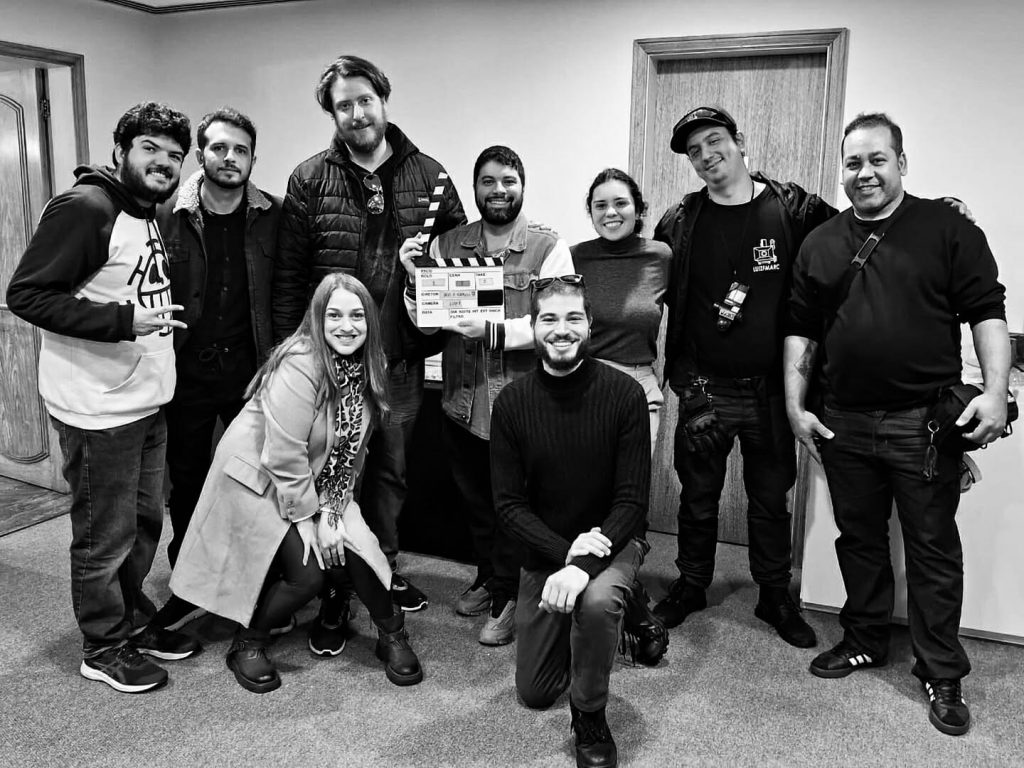
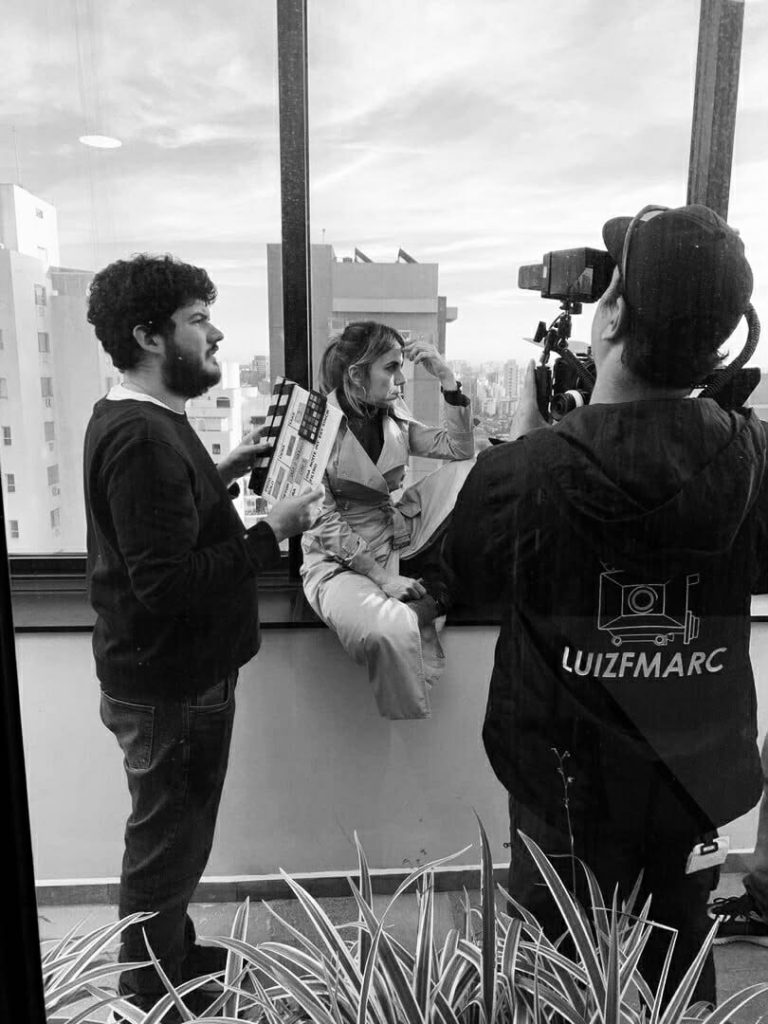
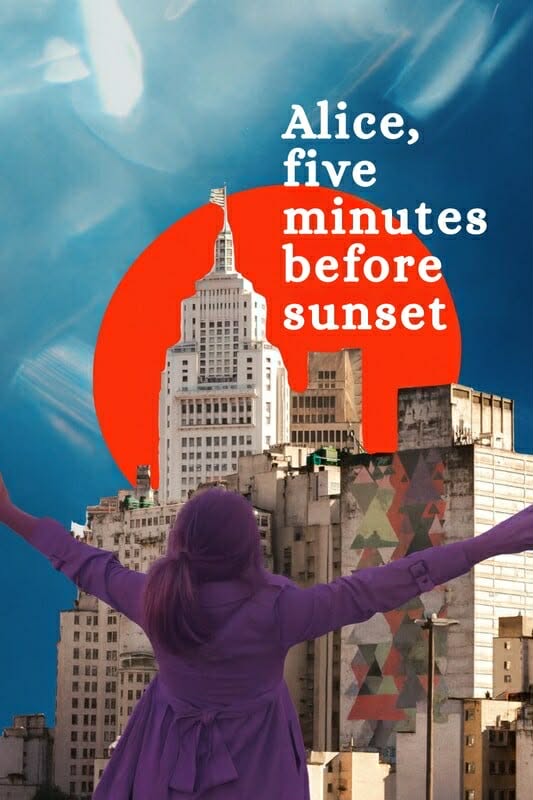
ALICE, FIVE MINUTES BEFORE SUNSET is a short film I co-directed with Rodrigo Ferraz, written by Ryan Ruiz.
It is a minimalist and poetic work, structured largely through voice-over narration and silence. The film follows a woman walking through São Paulo, and through this simple gesture we explore absence, memory, and inner fracture.
The aesthetic was influenced by Chantal Akerman’s use of duration and space, as well as the emotional restraint present in filmmakers like Sofia Coppola. Silence becomes dramaturgy.
Despite being a completely unbudgeted production, built entirely through artistic collaboration, the film is having a solid run at festivals. It premiered at the Culver City Film Festival in Los Angeles (Amazon Studios), was screened at the Indie Short Fest also in LA where we were finalists, and has already received two awards in India. In just a few months, it has reached about twelve festivals.
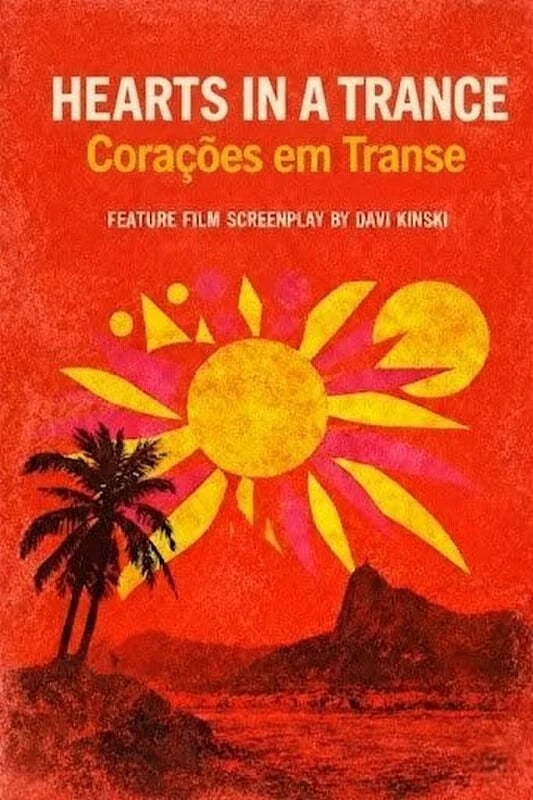
This journey reinforces my belief that cinema doesn’t depend on scale—it depends on conviction. At the same time, I am developing a screenplay for a feature film entitled “Hearts in Trance.”
It is an intimate drama set in contemporary Brazil, exploring ideological polarization, political tension, and the fragility of intimacy in an era shaped by spectacle and surveillance. Influenced by the urgency of Glauber Rocha and the political sensuality of Pasolini, the project examines how private relationships become battlegrounds for historical forces.
Winner of the Best Original Screenplay award at the New York Movie Awards and the Best LGBTQIA+ Screenplay award at the Caravan Film Festival in Kolkata, India.
Which director inspires you the most?
It’s difficult for me to name just one director, but if I had to start somewhere, it would be Pier Paolo Pasolini.
He occupies a unique place in my formation—not only as a filmmaker, but as a thinker. It’s no coincidence that I wrote a book about him. Pasolini moved through poetry, literature, philosophy, and journalism before arriving at cinema, and when he did, he transformed film into the ultimate synthesis of his language. This multidisciplinary trajectory resonates deeply with me.
What fascinates me most is not only his aesthetics—the “cinema of poetry”—but his intellectual courage. As early as the 1970s, Pasolini diagnosed what he called a new form of fascism, a new power structure rooted in consumerism, the media, and ideological manipulation. When we revisit him today, he seems almost prophetic. His work remains disturbingly contemporary in a world marked by polarization, extremism, and the erosion of critical thinking—in Brazil, in the United States, in Europe, everywhere. But my influences don’t stop there.
Ingmar Bergman was fundamental in shaping my understanding of intimacy and existential tension. Eduardo Coutinho, one of Brazil’s greatest documentary filmmakers, profoundly influenced my approach in POEMARIA—especially his belief in the power of presence and speech. I’m also inspired by Pedro Almodóvar’s emotional audacity and his ability to blend melodrama with psychological complexity.
If I were allowed, I could cite fifteen directors. Cinema is a constellation of influences.
But Pasolini remains, for me, both an artistic compass and an intellectual provocation—someone who reminds us that cinema should not only be beautiful, but necessary.
What do you hate about the world and what would you change?
What worries me most about the world today is the erosion of empathy.
When empathy disappears, dialogue also disappears. And when dialogue disappears, bridges break. What remains is polarization, intolerance, extremism—the fragmentation we witness globally. Wars, ideological radicalization, the inability to listen—these are symptoms of a deeper disconnection from what is fundamentally human.
Pasolini warned about this decades ago. He spoke of a new form of power—subtle, omnipresent, that shapes consciousness through media and consumer culture. His films, from *Teorema* to *Salò*, were not provocations to shock; they were diagnoses. He understood that when a society loses its moral and emotional imagination, it begins to repeat its darkest cycles.
We live in a paradoxical era: never before have we had so much access to information, so much global connectivity—and yet, we seem increasingly isolated within ideological bubbles. Technology connects us structurally, but empathy connects us ethically. Without it, progress becomes regression.
If I could change something, it would be this:
I would restore the capacity for deep listening—for recognizing the vulnerability of others. Because without this recognition, history tends to regress instead of advance.
And cinema, for me, remains one of the few spaces where empathy can still be practiced—where we are invited to inhabit lives that are not our own.
How do you imagine cinema in 100 years?
In a hundred years, cinema will undoubtedly transform in its form—new technologies, immersive environments, expanded realities, perhaps even dissolving the traditional boundaries between spectator and image. The relationship between screen and spectator may become more fluid, more interactive, perhaps even more individualized.
But I believe its essence will remain intact.
From the first screenings by the Lumière brothers to the radical reinventions of filmmakers like Dziga Vertov, Andrei Tarkovsky, or Agnès Varda, cinema has always been less about machines and more about perception. It’s a way of organizing time, of sculpting memory, of confronting reality. Technologies evolve; the human need to see ourselves reflected does not.
Even in an era increasingly shaped by artificial intelligence and algorithmic consumption, cinema will survive if it preserves what made it powerful in the first place: the ability to create interruptions. To slow us down. It forces us to encounter—silence, contradiction, vulnerability.
The format may expand beyond the dark movie theater. The image may become holographic, immersive, decentralized. But as long as there are human beings searching for meaning, cinema—like literature, theater, or music—will reinvent itself around that search.
A hundred years from now, cinema may seem strange.
But if it continues to question who we are, it will still be cinema.
What are your thoughts on WILD FILMMAKER?
I was truly honored by the invitation from WILD FILMMAKER. It’s a respected platform in the international film scene, and seeing the variety of filmmakers who have shared their work and ideas through the magazine, I felt both humbled and grateful to be among them.
As a filmmaker still at the beginning of my feature film journey, this recognition has a special meaning. It suggests that attentive curators are looking beyond established circuits and connecting with emerging voices—especially those from Latin America who propose a more auteur-driven and poetic approach to cinema.
I believe that platforms like WILD FILMMAKER play an important role in connecting different film cultures and expanding dialogue across borders. If Brazilian and Latin American cinema has something urgent and poetic to say, it is through spaces like yours that these voices can resonate globally.
Therefore, I sincerely thank you for the opportunity and wish the magazine continued growth, relevance, and longevity in the international film community. Brazilian kisses and hugs.
I am a father, a grandfather, and a recovering addict. Those experiences motivate my filmmaking – to search for wonder, walk through pain, hope for love, and explore the world with a wide lens. We only have so much time to figure this all out. The days get shorter – not longer.
Do you remember the exact moment you fell in love with cinema?
I do, It was Jaws – though probably not for the reasons most people cite. Of course, the Indianapolis speech is incredible, but I didn’t fully appreciate what Robert Shaw accomplished there until much later in life. As a kid, when I first watched Jaws, it was the quiet moments that I later realized stayed with me. The evening ocean cinematography – even filtered – still evokes wonder. Those scenes invite your mind to search for what you don’t know. Then the music hits.
Tell us about your project “Vagabond In Red: Iquitos“.
As a recovering addict with decades clean, I’ve experienced a lot of loss and hundreds of deaths. Being part of a 12-step program gave me a good life, and I’m grateful. But each day is a choice – I choose life. Even after working the steps and following suggestions, I’ve still had dark moments and times where I felt I held myself back. I’ve watched friends with decades of sobriety relapse and die.
Over time, treatment has changed. Doctors now often prescribe medication immediately after rehab – something that wasn’t common during the first decades of my recovery. At the same time, many institutions designed to support people with mental health conditions were closed because medications were believed to solve many issues – but addiction hasn’t disappeared. New street drugs seem to have made it worse, and new street drugs will continue to evolve. Homelessness has only grown, and many people struggle to stay on medications, with some even hitting a wall many years later where existing medications no longer seem to be effective.
So – what is the sixth and final episode of Vagabond in Red about? Besides looking at the commonality that a location like the Peruvian jungle shares with the rest of humanity – it really centers on healing trauma. I hope it asks whether there are ways beyond pharmaceutical medicine to address our shared traumas and the broader human condition. Is every prescribed medication the answer? What really is medicine? As a person in recovery, it took a lot of soul searching and decades of research for me to get to the point where I was willing to do some investigative work outside of my own realm of understanding. I walked away believing I did the right thing.
Which director inspires you the most?
Spielberg, obviously – because of Jaws. But I’m also deeply influenced by Tarantino’s use of soundtrack to evoke feeling. Music in film – like in Jaws and others – creates three-dimensional visions in my head. Images drive music choices, and music drives imagery. Then there’s an additional four-dimensional element that hits when making film. My own emotions, past trauma, and inner life, and maybe soul, mixed with the beats, lived experiences, and images, help put my thoughts to film.
What do you dislike about the world, and what would you change?
There’s a lot. But if we could move from inequality toward equality, that would change everything. It would bring hope and reduce the fear that so many people live with. That said, if you want to experience the best the world has to offer, you have to go out and experience it directly. There are wonders far outside our normal scope of lived experience. Get off the couch! Don’t use cruise ships to expand your mind. Take risks.
How do you imagine cinema in 100 years?
I think concerns about AI creating instead of humans are valid. The path I’ve chosen – documenting lived experience – is relatively safe for now. There’s still so much of the world and culture that needs to be documented before it disappears. Cinema won’t disappear, but the way it’s packaged and presented will evolve. I’d be lying if I didn’t say putting on that Apple headset didn’t blow my mind.
What is your impression of WILD FILMMAKER?
I like what WILD FILMMAKER is doing. It’s making shared ideas and connections more accessible within the filmmaking community. I believe strongly in shared connections. I think both Vagabond in Red and my current project Nunnehi – which uses the Appalachian Basin as a microscope to explore human traumas and connections over the last couple hundred years – hopefully reflect some of what WILD FILMMAKER is accomplishing by touching on connection.
Keep up what you’re doing. We need more voices in the world. Maybe now more than ever.
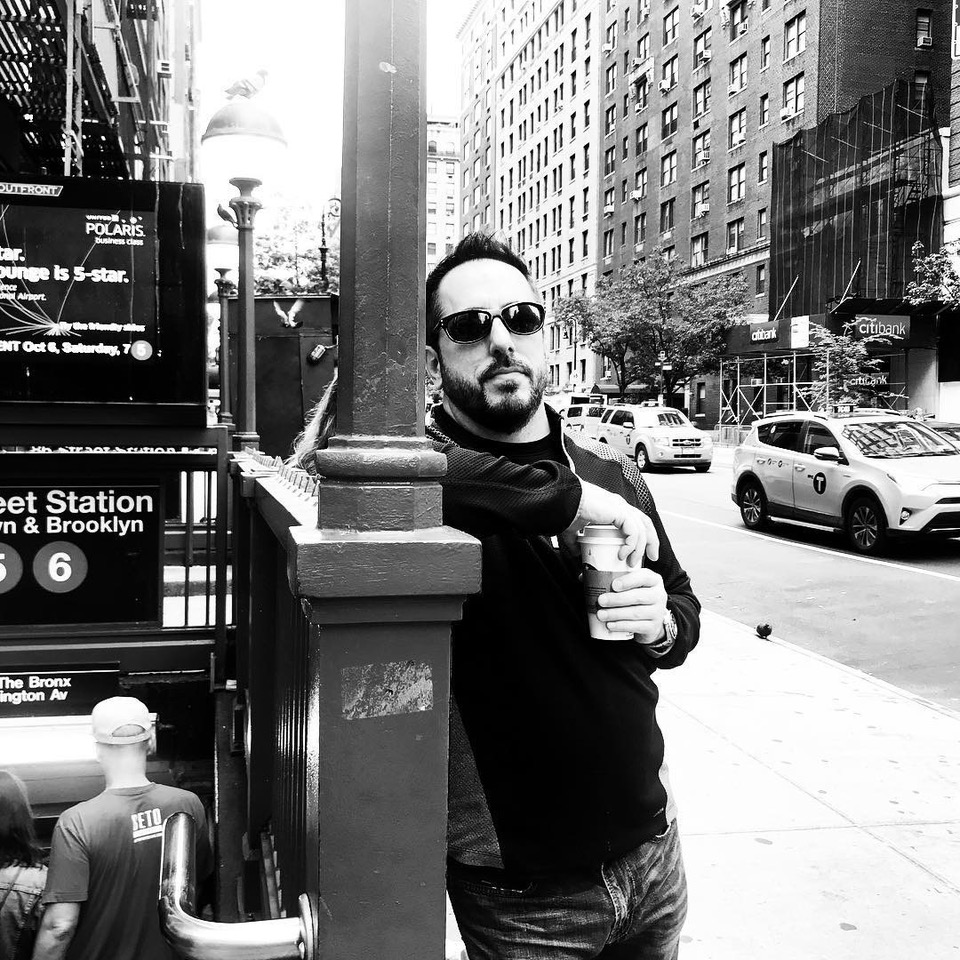
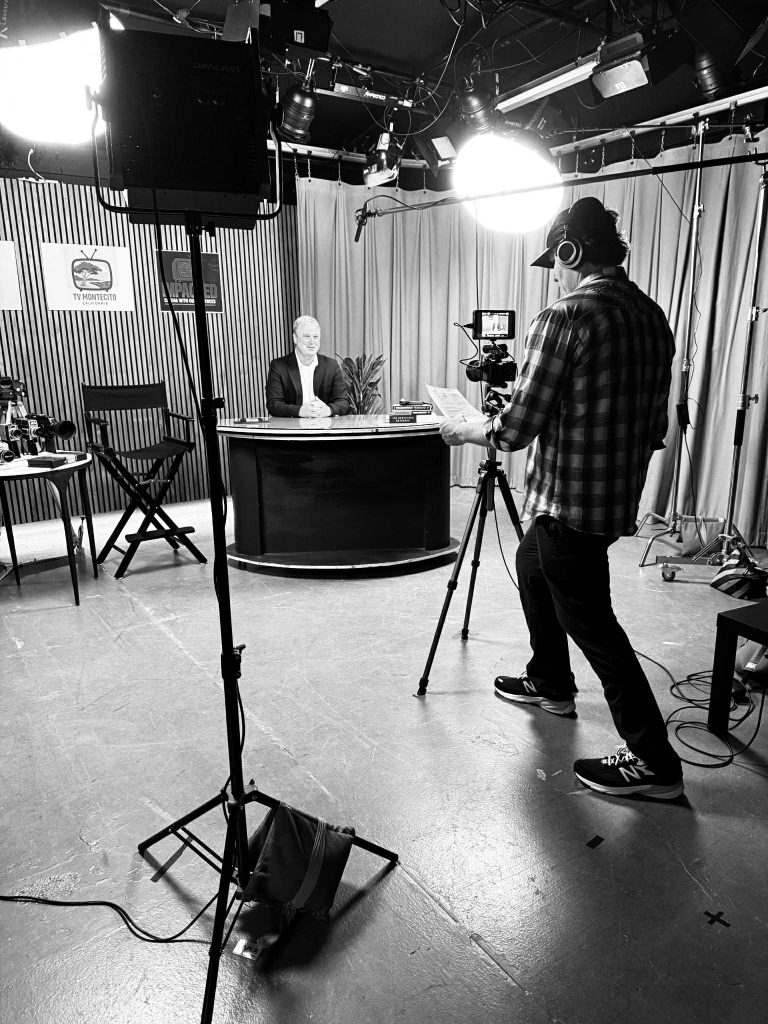
John Myrick was born in Kansas City, Missouri and raised in El Paso, Texas. After a super brief college football stint at UTEP ended by a knee injury, he found himself on the El Paso set of Walter Hill’s Last Man Standing, where Christopher Walken praised his ability to convincingly lie dead on a cold, icy car in the desert. John took this as a sign, the cinema gods were calling!
He enrolled into the Brooks Institute of Photography in Santa Barbara, making dozens of emotionally shallow short films and attending film festivals. At one screening, his film print literally combusted in the projector. The audience applauded. John cried. Both reactions were correct.
Do you remember the exact moment you fell in love with cinema?
I was probably exposed to movies a little too young in the 1980’s, thanks to at home cable channels like HBO, Showtime, and Cinemax. One summer it felt like Conan the Barbarian, Mad Max, The Road Warrior, Star Wars, Superman, Jaws, and Animal House were playing on an endless loop. I was just a kid, but I was completely hooked.
In the 1990s, a “guru-type” guy at my local video store told me I had to watch Reservoir Dogs. Back when video store employees had their own curated sections, that recommendation hit hard. The commode story, Tim Roth rehearsing it, then the cut to him performing it in front of the mobsters felt like a flash of brain lightning! That was the moment I realized cinema had a much bigger canvas than I’d imagined, and I was drawn to it.
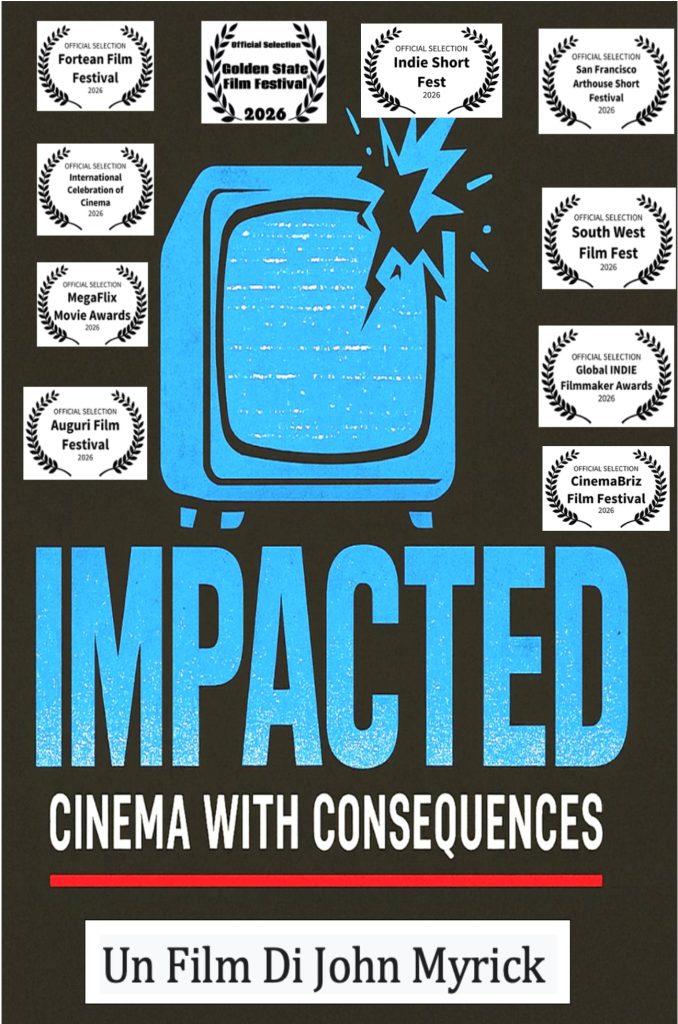
Tell us about your project “Impacted”.
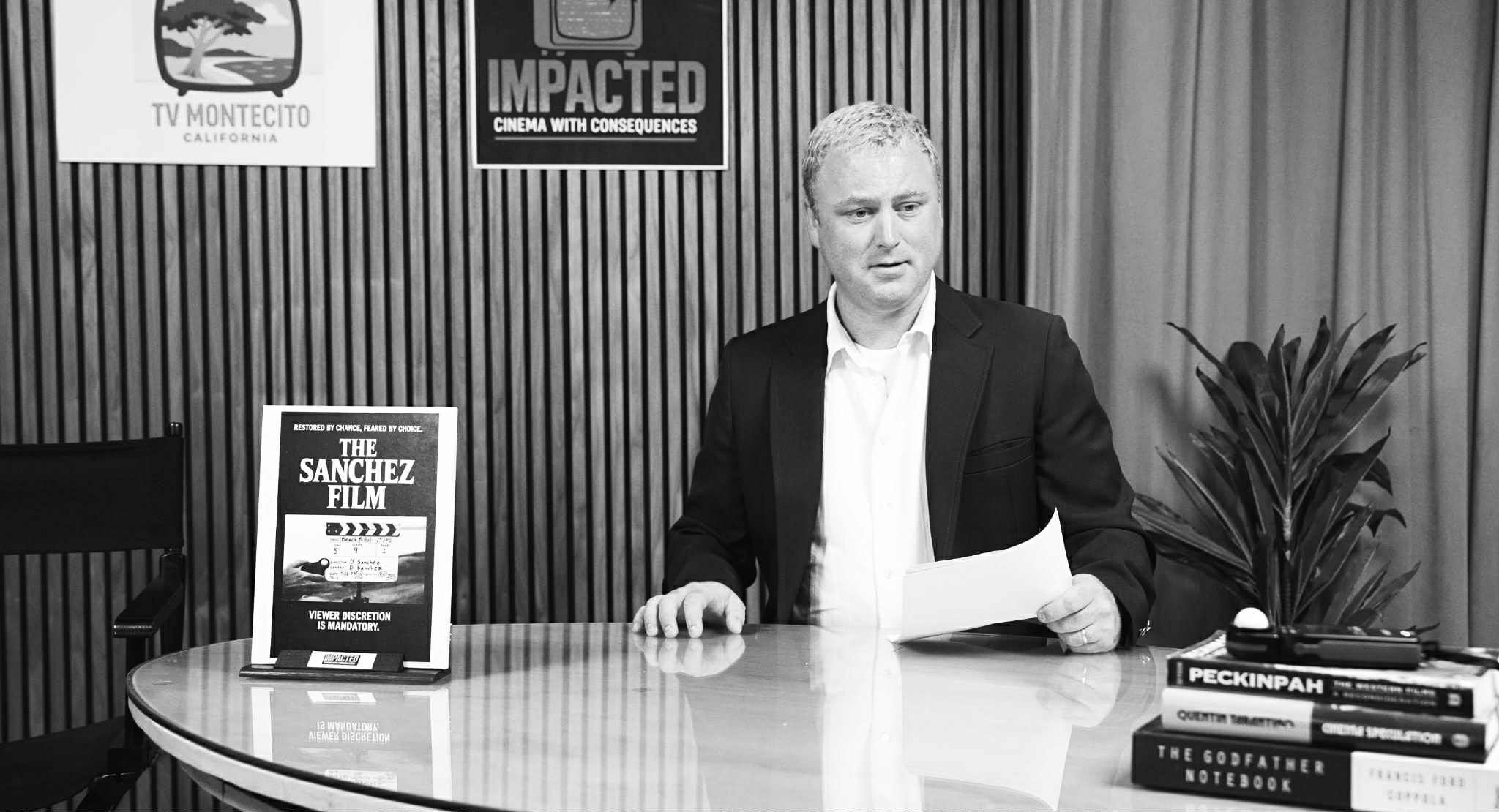
I walk my two pit-mix rescue dogs, Riggins and Stevie, every morning, usually in Santa Barbara or West Hollywood. One June morning during our signature fog, I was walking them on the beach with almost no visibility. The ocean was completely still and quiet, and it felt like a black-and-white Twilight Zone set. I remember thinking: what if I stumbled onto something strange out here? I was totally alone except for the dogs.
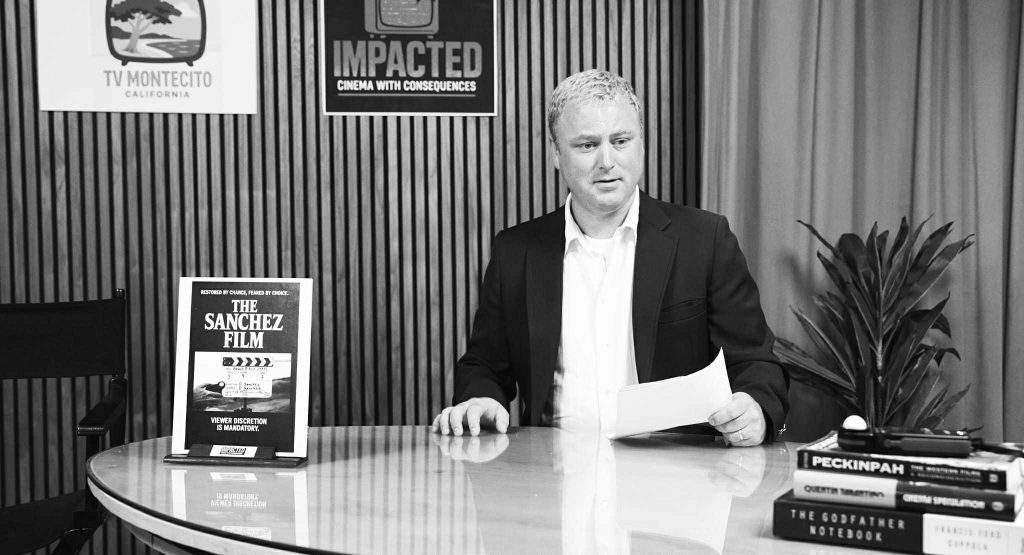
That image stuck with me and became the seed of a short story about a man with a film camera shooting b-roll who captures something unsettling under lonely, low-visibility conditions (The Sanchez Film). From there, the idea expanded into the A-story: a local access TV program called Impacted—”the best cinema appreciation show on local access”—that takes on the restoration of the old black-and-white footage. Thanks to our local sponsors (my real-life SB friends Boss HossBarbeque and Wise Acres Winery and a special nod to Pump and Dump, a parody of a local septic pumping company with Disney-like commercials). Things quickly go off the rails when the intern handling the restoration turns out to be obsessed with horror films and recuts the material to be genuinely terrifying. Since it’s local access, I leaned hard into the low-budget, DIY chaos of it all, which ultimately led to a fun, strange short film that embraces those limitations rather than hiding them.
Which Director inspires you the most?
I’ve been inspired by different directors at different times Milius, Scorsese, Coppola, Tarantino, Peckinpah, Nolan, and more recently PTA and Sean Baker. That said, Christopher Guest had a big subconscious influence on Impacted, especially the love of low-budget chaos and absurd humor.
What do you dislike about the world and what would you change?
Ha – honestly, we don’t need any more profit-obsessed shortsighted CEOs! When is enough enough?! We need more artists, storytellers and original voices. People who make the world more imaginative, thoughtful, hopeful and human. That’s the change I’d like to see.
How do you imagine cinema in 100 years?
I think passionate stories will still be told, hopefully by underdog storytellers 🙂 Formats and technology are evolving fast. Will IMAX-style screens become the new normal? Will our phones shoot an IMAX type image with an app? Hopefully, all these changes open the door for underdog voices with something amazing to say about our shared human journey.
What is your impression of WILD FILMMAKER?
I’m new to Wild Filmmaker, but I’m really enjoying it! It feels fresh and a great platform for interviews and connecting with like-minded cinema enthusiasts.
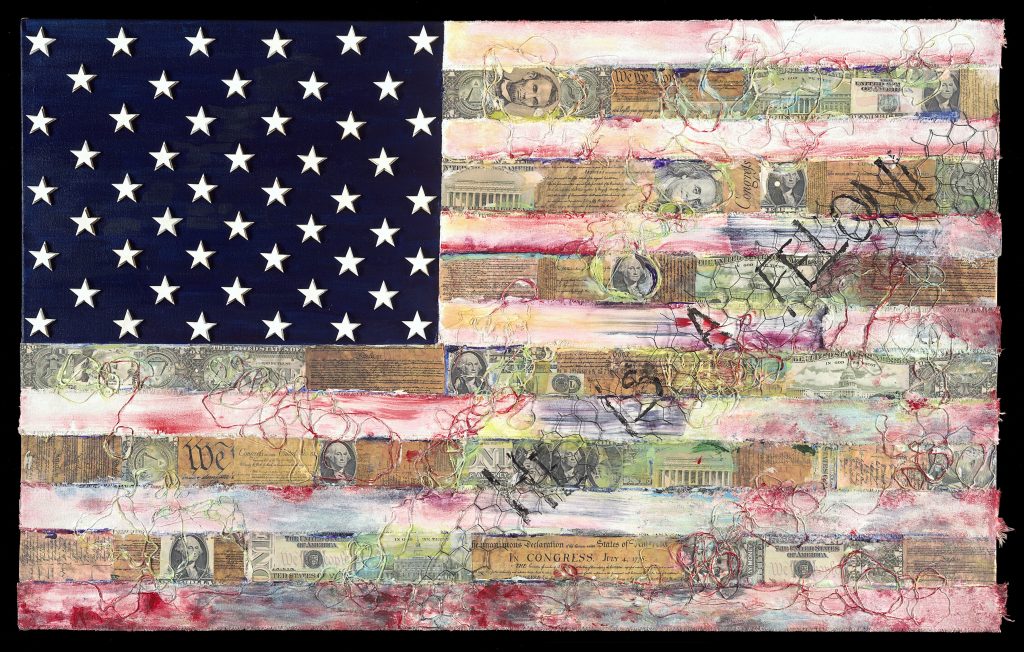
I am a sensory illusionist. My technique as a visual artist employs the integration of color, light and texture with many surface variations and includes mixed media. Sculpted Paintings® (my registered brand), uses the texture created by layering canvas on canvas.
The addition of the founding documents of the United States symbolizes the struggle we have endured. The colors that I use in the flag and landscape paintings embodies the beauty and wonder of our spirit and the written words found throughout the work are a testament to the very nature of who we are as a people.
As a filmmaker, Tipping Point has expanded the experience of seeing the images and prose and the impact on the viewer becomes of this moment and our shared experience moving forward.
As an artist, there is an attempt to balance what is stated and what is suggested. I hope to share my work through many mediums, and I aspire to convey personal insight through a universally understood concept.
-Do you remember the exact moment you fell in love with cinema?
After watching the Ten Fingers of Dr. T., I became intrigued with the story and its effect on my psyche. Later, I realized the memory of that film had a profound influence on my way of thinking as to what is possible in film, by the telling of the story and what is revealed in the imagery.
-Tell us about your project “Tipping Point”.
I am reminded of the story around The Statue of Liberty. Poet and activist Emma Lazarus wrote the poem “The New Colossus”, as a fundraising effort for the pedestal on which to place the statue.
The sonnet was not originally attached to the statue, but subsequently, became the identifying symbol of liberty.
Tipping Point is the culmination of my paintings and poetic prose to initiate a visual conversation around who we are and what we could aspire to as people living in this nation or any nation.
Everyone is searching for the hero to fix our current situation, but a hero isn’t an abstract concept.
It’s you, it’s me, it’s us, together. We are the heroes we have been searching for. We can remedy this situation that is unlike the very nature of who we are.
-Which Director inspires you the most?
My favorite projects include a bit of magic, the spark of creativity, the inclusion of invention of the unique and a sense of elevated style. I do not lean towards stories that have a literal way of viewing the world. I feel that most sophisticated work has grown beyond that way of storytelling.
-What do you dislike about the world and what would you change?
I try to work using my insight and skill and endeavor to create the realization of my vision.
This applies to every medium, even film. Yet, if the message is too distorted it will not be understood.
So, there is a need to be practical regarding the interplay between invention and reality.
-How do you imagine cinema in 100 years?
Our world has become so changed in the past one hundred years; we can only imagine what capabilities might be possible in the future. Surely technological advances will be a factor in what is said and how it is stated. Truly, I hope that we can use technology in positive ways to help all people have wonderful lives, that no one is sick or homeless or hungry. I feel real concern that there is already a battle for resources, but if these concerns are abated, then perhaps many people can use future technologies to create in unimagined ways.
-What is your impression of WILD FILMMAKER?
Thank you for using your platform, Wild Filmmaker to gather the thoughts and impressions, insights and creative processes of diverse creatives. It is an essential tool in exposing what is happening in the world of constantly evolving filmmaking.