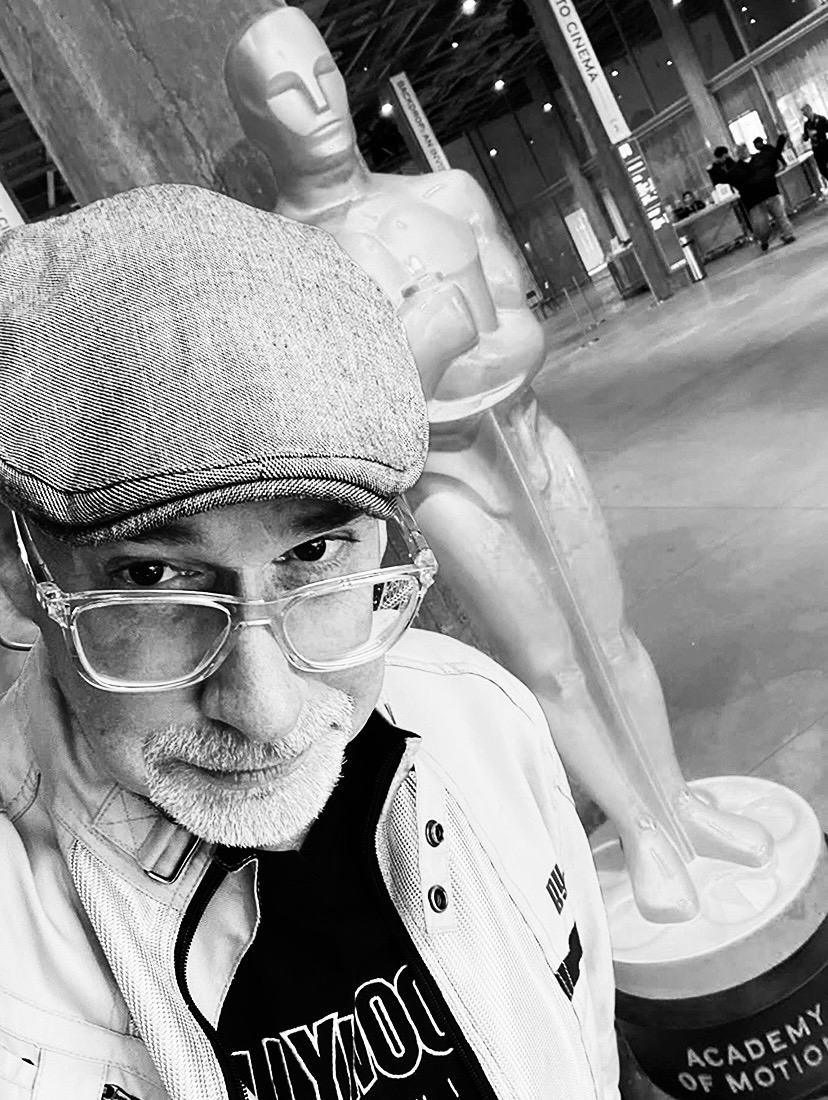
Born in Frankfurt am Main in November 1973, Kai has called Spain home since 1994.
His screenplay LAMBADA THE DANCE OF FATE made history, earning over 120 accolades across five continents — making him the most decorated debut screenwriter for a single biographical screenplay in cinema history.
Now, Kai turns a new and exciting page with his latest screenplay, MASTER HEIST – A True Christmas Fiction. Barely out of the starting gate, this bold new work has already captured 7 awards and 3 official selections on the international circuit — this includes winning the prestigious ABAFTA (Arthouse British Academy of Film and Television Arts) Awards 2026 and the Final Competition of the Indie Oscar 2026 in Los Angeles. The world, it seems, is once again paying close attention.
-When you plan the realization of a film project, what are your objectives?
When I plan the realisation of a film project, my objectives operate on several levels simultaneously — and they are all equally non-negotiable.
The first objective is always the story itself. Everything else — budget, casting, distribution, format — must serve the story, never the other way around. With both MASTER HEIST and LAMBADA THE DANCE OF FATE, the narrative architecture was built from the very beginning with a clear understanding of what each story needed to breathe. MASTER HEIST, for instance, was conceived with contained production value in mind — strong commercial appeal without sacrificing creative boldness. That balance is not an accident. It is a deliberate creative and practical decision.
The second objective is finding the right partnership. I have learned — sometimes the hard way — that the wrong collaboration can be more damaging than no collaboration at all. I am not simply looking for a producer or a director. I am looking for someone who understands what these stories are truly about. Someone who sees Mateo Vega, my protagonist, not just as a character, but as a statement. Someone who is as unafraid of the edge as I am.
The third objective is longevity. I do not write films I want people to watch once and forget. MASTER HEIST is already conceived to function as both a standalone feature and a natural entry point into a limited series — because the best stories deserve room to expand, to breathe, to surprise you a second time.
-With Artificial Intelligence, cinema is undergoing a phase of transformation even more radical than the one that occurred in the 1920s with the transition from silent films to sound. What is your opinion on this?
This is perhaps the most urgent and fascinating question facing cinema today — and I think it demands honesty rather than comfort.
Artificial Intelligence is not coming for cinema. It is already here. And yes, I believe the transformation it is triggering is every bit as radical — perhaps even more so — than the seismic shift from silent film to sound. That transition changed the technology of storytelling. What AI is doing now goes deeper. It is challenging the very definition of authorship, of creativity, of what it means to make something.
And that terrifies some people. I understand why. But it does not terrify me.
Here is what I believe. AI is a tool — the most powerful and most misunderstood tool the creative world has ever been handed. Like any tool, its value is entirely determined by the hands that hold it. A camera in the wrong hands produces nothing of consequence. The same camera in the hands of a Coppola or a Kubrick changes the world. AI will be no different.
What AI cannot replicate — what it will never replicate — is genuine human experience. The specific weight of loss. The particular texture of longing. The irrational, magnificent, destructive hunger of someone like Mateo Vega, who burns everything down just to be heard. Those things do not come from an algorithm. They come from a life actually lived.
My concern is not that AI will replace great storytellers. My concern is that the industry, in its perpetual chase for efficiency and profit, will use AI as an excuse to stop looking for them.
The transition to sound silenced some voices and amplified others. AI will do the same. The question — the only question that matters — is whether the industry will have the courage to ensure that the voices it amplifies are the ones with something real and necessary to say.
I intend to be one of those voices. With or without the machine.
-To which production or distribution company would you like to propose your new project? Give us a profile, including some examples.
This is a question I have thought about deeply — because the right home for MASTER HEIST is not simply the biggest name or the deepest pockets. It is the right creative culture. The right appetite for bold, original, commercially viable storytelling.
With that in mind, there are several companies that represent exactly the kind of partnership I am looking for.
A24 sits at the very top of that list. They have built something genuinely rare in modern Hollywood — a brand synonymous with creative courage and artistic integrity that nonetheless delivers consistent commercial results. Films like Everything Everywhere All at Once, Hereditary, and Midsommar prove that A24 understands something most studios have forgotten — that audiences are hungry for the unexpected. MASTER HEIST, with its meta-cinematic boldness and darkly original premise, feels entirely at home in their catalogue.
Working Title Films is another natural fit — particularly given the European dimension of my work. With a legacy that spans Four Weddings and a Funeral, Atonement, and The Theory of Everything, Working Title has consistently demonstrated an ability to bridge intimate, character-driven storytelling with genuine international commercial appeal. That balance is precisely what both my screenplays are built on.
Canal+ and StudioCanal represent the European pathway — and given the distinctly Mediterranean soul at the heart of MASTER HEIST, a company with deep roots in European cinema and strong international distribution infrastructure would be a powerful ally. StudioCanal’s history with films like Paddington, The Motorcycle Diaries, and Blue Is the Warmest Colour demonstrates a remarkable range and a genuine commitment to stories with a distinctive cultural identity.
For the streaming dimension — and given the series potential already built into MASTER HEIST — Netflix and Apple TV+ are the natural conversations to be having. Apple TV+ in particular has shown an extraordinary willingness to back original, ambitious projects from distinctive voices. The Banshees of Inisherin, Killers of the Flower Moon — these are films that take their audience seriously. That is exactly the company I want to keep.
Ultimately, the ideal partner is one who sees what I see — that MASTER HEIST is not just a film. It is a franchise, a conversation, and a statement. And that the audience waiting for it is larger, and hungrier, than anyone might yet imagine.
-WILD FILMMAKER can now “sit at the table with the big players” alongside The Hollywood Reporter and Variety during the Cannes Film Festival, but we have chosen to continue being a Global Cultural Movement with an ethical mission: to bring democracy into cinema, placing the Work of Art at the center of our project rather than Marketing. Do you think we are doing a good job?
Absolutely — and I want to say this with complete sincerity: Wild Filmmaker is doing an extraordinary job. Not just a good job. An extraordinary one.
What you have built is something the industry genuinely needs and, if we are honest, has been afraid to build for itself. The fact that Wild Filmmaker can now sit at the same table as The Hollywood Reporter and Variety during Cannes is not a small thing. That is a seismic shift. That is years of relentless work, uncompromising vision, and the kind of stubborn belief in something bigger than commercial gain that the industry rarely rewards — until suddenly, it cannot ignore it anymore.
But here is what I find most compelling about Wild Filmmaker’s position — and this is something I feel deeply as a filmmaker and screenwriter myself. You have chosen to remain a Global Cultural Movement with an ethical mission. To place the Work of Art at the centre, rather than the marketing machinery that so often suffocates it. That choice, made from a position where you could have easily gone the other way, says everything about the integrity of what you are doing.
And yet — and this is important — one does not necessarily rule out the other. Sitting at the table with the big players and maintaining an ethical, democratic mission are not opposing forces. They never were. In fact, I would argue that the most powerful position in any industry is the one where you have earned the respect of the establishment while refusing to be defined by it. That is exactly where Wild Filmmaker stands today.
Democracy in cinema is not a romantic ideal. It is a necessity. The greatest stories are not always born in the biggest offices or backed by the deepest pockets. They are born in the margins, in the overlooked corners, in the minds of people who were told the table was not for them. Wild Filmmaker pulls up a chair for those people. And in doing so, it makes the entire conversation richer, sharper, and more alive.
As someone who has experienced firsthand what it means to fight for a story that the mainstream was not yet ready to hear — I am genuinely grateful that platforms like Wild Filmmaker exist. You don’t just report on cinema. You’re changing what cinema can be.