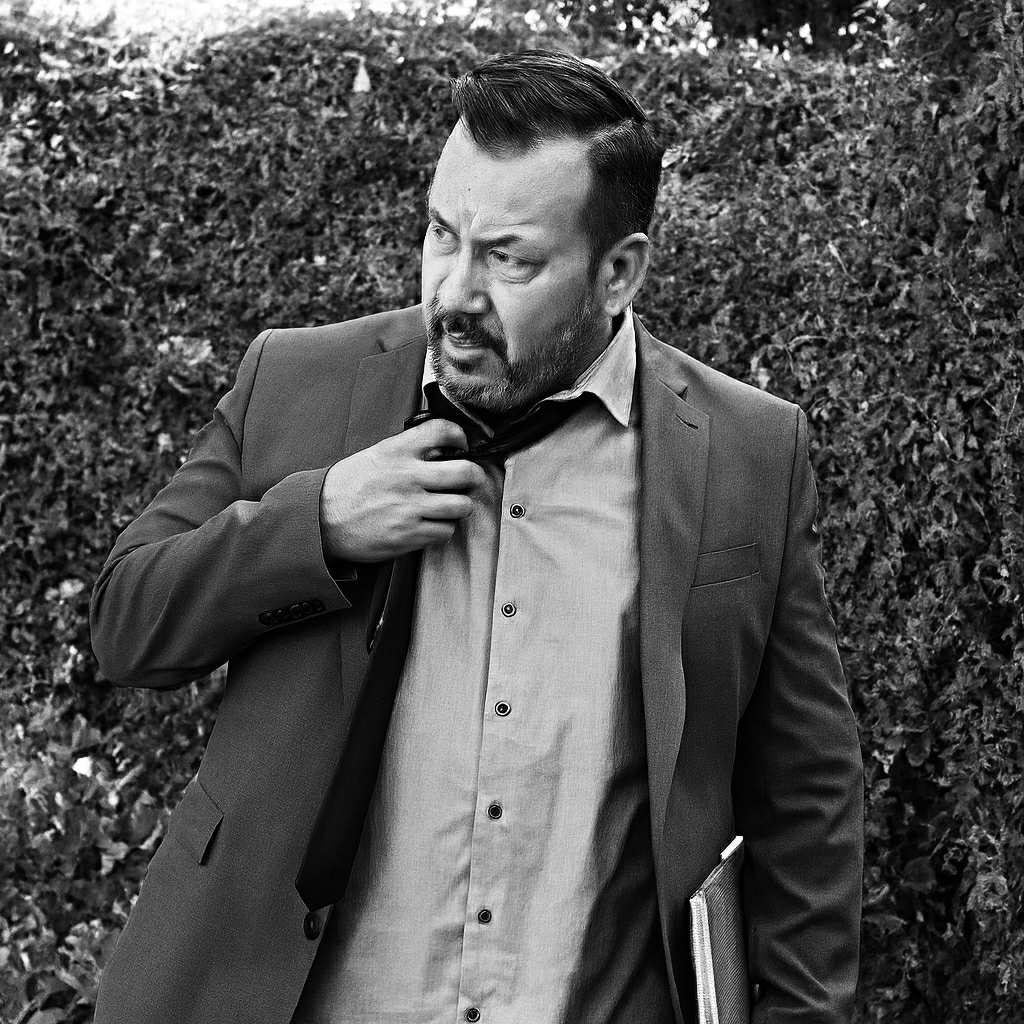
Who is Cresencio Medina?
I’m a full-time FedEx courier, working hard every day to provide for my family — but inside my heart, I’m a storyteller, a filmmaker, and a dreamer who never stopped believing in the power of cinema. My journey has been one of resilience and vision — balancing long workdays, fatherhood, and the challenges of life while holding onto a dream to create stories that matter. I was born in Yuma, Arizona, to a father from Jalisco and a Mexican-American mother, carrying Yaqui roots that have shaped who I am. I grew up in El Centro, California, and earned my Associate’s Degree from the Los Angeles Film School — a place where I was finally able to express who I really am. It wasn’t just about learning filmmaking; it was about finding my voice, my purpose, and the meaning behind the stories I wanted to tell. I’ve loved movies since I was seven years old. They gave me hope, direction, and the belief that imagination can change lives.
Today, my two sons — ages three and seven — are my greatest inspiration. They remind me daily why I keep pushing forward, why I write late into the night after work, and why I refuse to let go of my dream. They add fire to my passion and remind me that storytelling isn’t just about imagination — it’s about legacy, love, and leaving something behind that means something.
Do you remember the exact moment you fell in love with cinema?
Yes, absolutely. The first time I saw Christopher Reeve’s Superman, I truly believed a man could fly. When I was 7, my parents bought me a pair of Superman pajamas, and the moment I put them on, I believed, with all my heart, that I could fly. Not because someone told me, but because cinema showed me. That moment didn’t just spark my imagination; it defined it. It taught me that stories weren’t just for watching, they were for living, for telling, and for changing lives.
Tell us about your project PACO.
PACO is a deeply personal story for me. It’s a fantasy adventure series set in 19th-century Jalisco, Mexico, centered around a young boy named Paco who gains superhuman strength after making a heroic sacrifice for his family. The story blends Mexican history, indigenous spirituality, and universal themes of courage, destiny, and the unbreakable bond of family.
Right now, PACO exists as a seven-episode screenplay series that I wrote. It’s filled with humor, adventure, and heartfelt moments that capture the beauty and chaos of family life — even in the face of danger. Paco’s journey takes him from playing with his sisters in the countryside to battling ruthless bandits and confronting an ancient, evil being that threatens everything he loves.
At its core, PACO isn’t just an adventure tale, it’s about legacy and identity, about how courage can come from love, and how stories can outlive time itself. The series has already received recognition in several film festivals, and I truly believe it has the power to connect with audiences around the world, not just as fantasy, but as a story about heart, hope, and what it means to protect the ones you love.
Which director inspires you the most?
Christopher Nolan has always inspired me. I’ve always admired how fearless he is when it comes to storytelling — how he bends time, emotion, and structure without ever losing the human truth behind his films. His first breakout film, Memento, based on his brother Jonathan Nolan’s short story Memento Mori, is a movie I absolutely love. The way it was shot and edited, starting from the ending and unfolding backward until it circled back to the beginning — completely changed how I saw storytelling. It wasn’t just a movie; it was a puzzle, an experience that demanded attention and rewarded you for piecing it together. Nolan showed me that storytelling can be both intelligent and deeply personal. That film didn’t just inspire me; it made me fall even deeper in love with the art of filmmaking.
What do you dislike about the world and what would you change?
What I dislike most is inequality — the way opportunity, safety, and even dreams are distributed unevenly depending on where you are born or who you are. If I could change one thing, it would be to create a world where children everywhere grow up with equal access to education, art, and opportunity. Stories can play a role in that by reminding us of our shared humanity and by sparking empathy where it’s needed most.
How do you imagine cinema in 100 years?
When I was 12 years old, I asked a teacher at school what she thought was the greatest love story ever told in a film. She smiled and said, “Myra and Roy, a film called Waterloo Bridge.” That answer stayed with me, because it showed me how powerful cinema can be — how a story from decades ago can still touch someone’s heart so deeply.
Today, with artificial intelligence becoming a part of almost everything, I sometimes wonder what cinema will look like in another hundred years. I imagine it will be even more immersive, blending physical and digital realities in ways we can’t yet fully understand. And while that future is exciting, it also makes me a little afraid, because no matter how far technology goes, nothing can replace the emotion, vulnerability, and truth that come from human storytelling. A hundred years from now, no matter how advanced cinema becomes, audiences will still crave the same thing — stories that move them, that make them feel, and that remind them of what it means to be human.
What is your impression of WILD FILMMAKER?
I think WILD FILMMAKER represents something powerful, not just as a magazine, but as a movement — giving filmmakers like myself a platform to share our vision and our stories. I admire how it celebrates independent voices and reminds us that storytelling doesn’t have to follow rules, it just has to come from the heart.
But beyond being a publication, I see “WILD FILMMAKER” as a state of mind — someone who dares to dream big, to take chances no matter the obstacles, and to tell beautiful stories even when the world says it’s impossible. That’s what true artistry is: creating not for approval, but because you must. I’m honored to be featured by a magazine that believes in that spirit — the wild, fearless pursuit of storytelling that moves people.